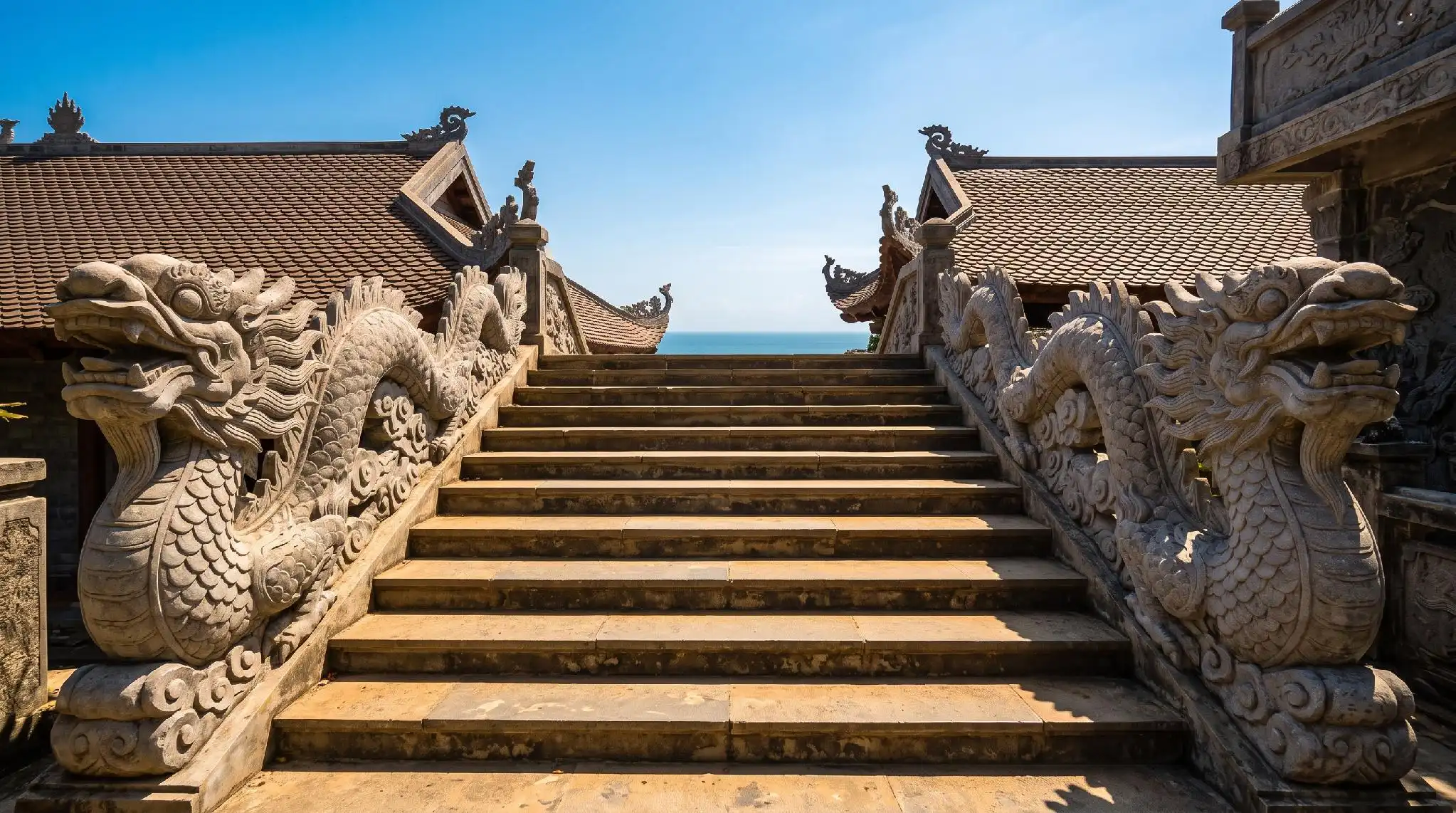
Ask most travelers what Phu Quoc is known for and the answer stops at beaches and seafood. It rarely reaches the hillside temple with a 70-step dragon staircase and a Guanyin statue watching over the open sea.
This guide covers that temple in full, then works outward to the handful of other genuine sacred sites worth a stop for anyone researching a Phu Quoc pagoda beyond the obvious postcard shot.
Ho Quoc Pagoda at a Glance
- Overview: This guide covers Ho Quoc Pagoda, Phu Quoc’s largest temple complex, from entrance details to the story behind it.
- Highlight: Also known as Truc Lam Ho Quoc Monastery, it’s the largest temple complex on Phu Quoc and across the wider Mekong Delta.
- Visiting: Ho Quoc Pagoda charges no entrance fee and is open daily from 6:00 in the morning until 6:00 in the evening.
- Recommended for: Useful for travelers planning a half-day cultural stop alongside Phu Quoc’s beaches.
Ho Quoc Pagoda: Phu Quoc’s Largest Temple
Ho Quoc Pagoda, also known as Truc Lam Ho Quoc Monastery, is the largest temple complex on Phu Quoc and across the wider Mekong Delta region. Construction began on 14 October 2011 and the pagoda was officially inaugurated just 14 months later, on 14 December 2012, a genuinely fast build for a complex of this scale.
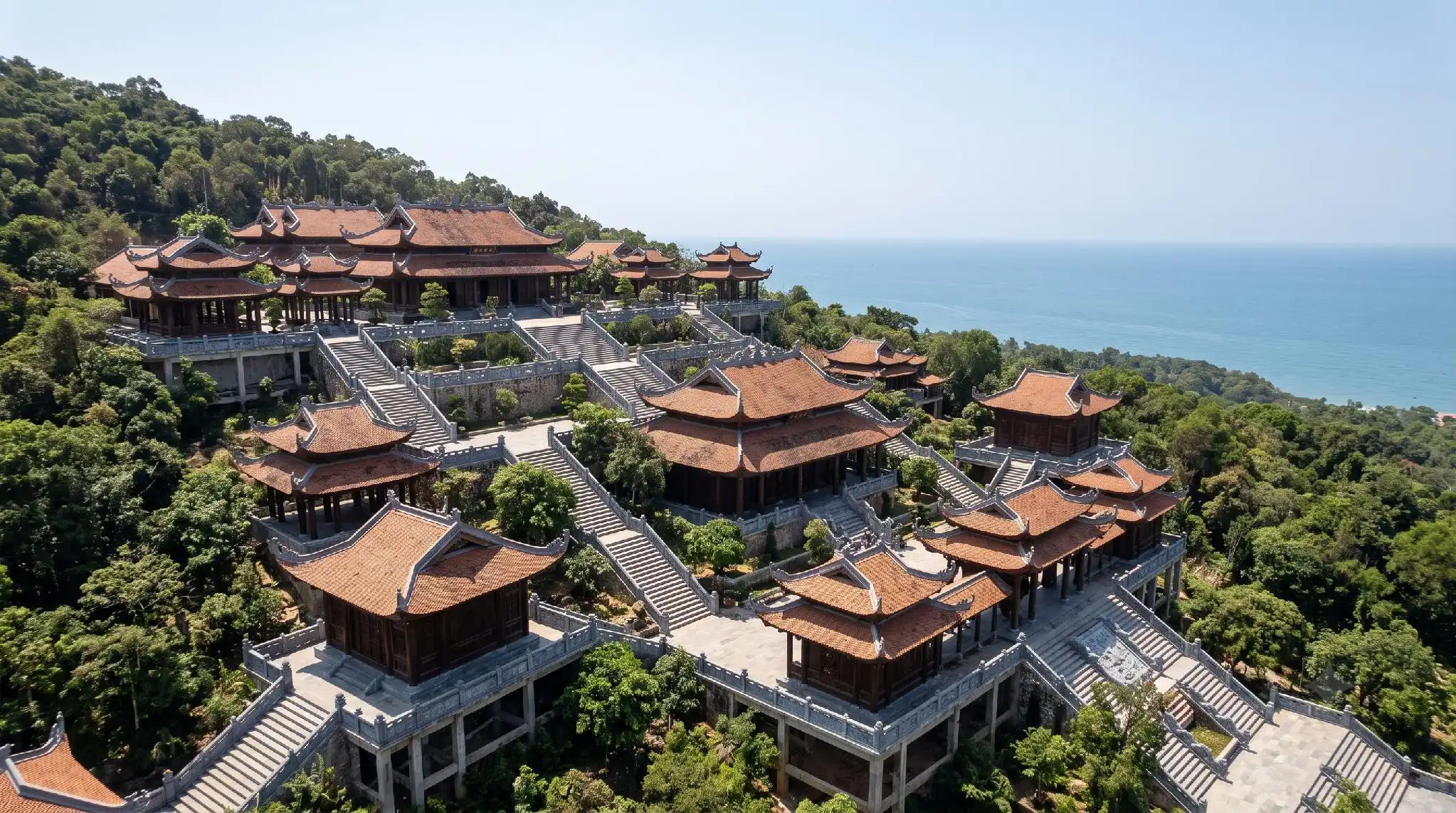
The name Ho Quoc translates roughly to “protecting the nation,” reflecting its position near the edge of Vietnam’s maritime territory. Every hall and gate is built from lim wood, a dense ironwood prized across Vietnam for lasting centuries with minimal decay, and the roofline carries the dragon-scale tiling pattern associated with Ly-Tran dynasty temple architecture, the style the whole complex draws its visual language from.
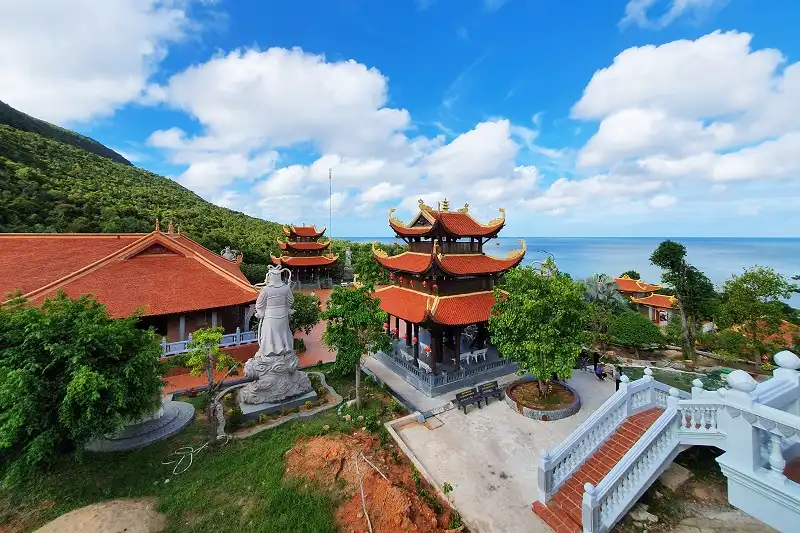
The grounds spread across a hillside site of several hectares, terraced into distinct levels rather than built on a single flat plot, with forested slopes bordering the complex on two sides. That layout is part of why this particular Phu Quoc pagoda reads as noticeably larger in person than most photographs manage to convey: the climb from the entrance gate to the upper courtyard genuinely passes through several distinct spaces rather than one continuous hall.
Visitor numbers run heaviest around Lunar New Year and on the first and fifteenth days of each lunar month, when local families arrive to pray for the month ahead. Outside those windows, the pagoda stays comfortably uncrowded even at midday, which makes flexible scheduling one of the easier parts of planning a visit to this particular Phu Quoc pagoda ahead of time.
Why its scale sets it apart from other island temples
Also known as Truc Lam Ho Quoc Monastery, Ho Quoc Pagoda is the largest temple complex not just on Phu Quoc but across the entire Mekong Delta region.
That scale is part of what makes it worth the trip even for travelers who don’t normally seek out temples on a beach holiday.
How to Get to Ho Quoc Pagoda
The pagoda sits on the same southern stretch of road that also runs down toward Khem Beach and An Thoi, which makes it a genuinely convenient stop depending on which end of the island a trip starts from. The route in differs slightly depending on whether a trip begins in Duong Dong town or from a beach base further south.
From Duong Dong Town
From central Duong Dong, follow Nguyen Van Cu Street south, then turn onto Hung Vuong Street and continue for roughly 18 kilometres to reach the pagoda gate, a drive that typically runs 25 to 30 minutes by taxi or rental car depending on traffic through town.
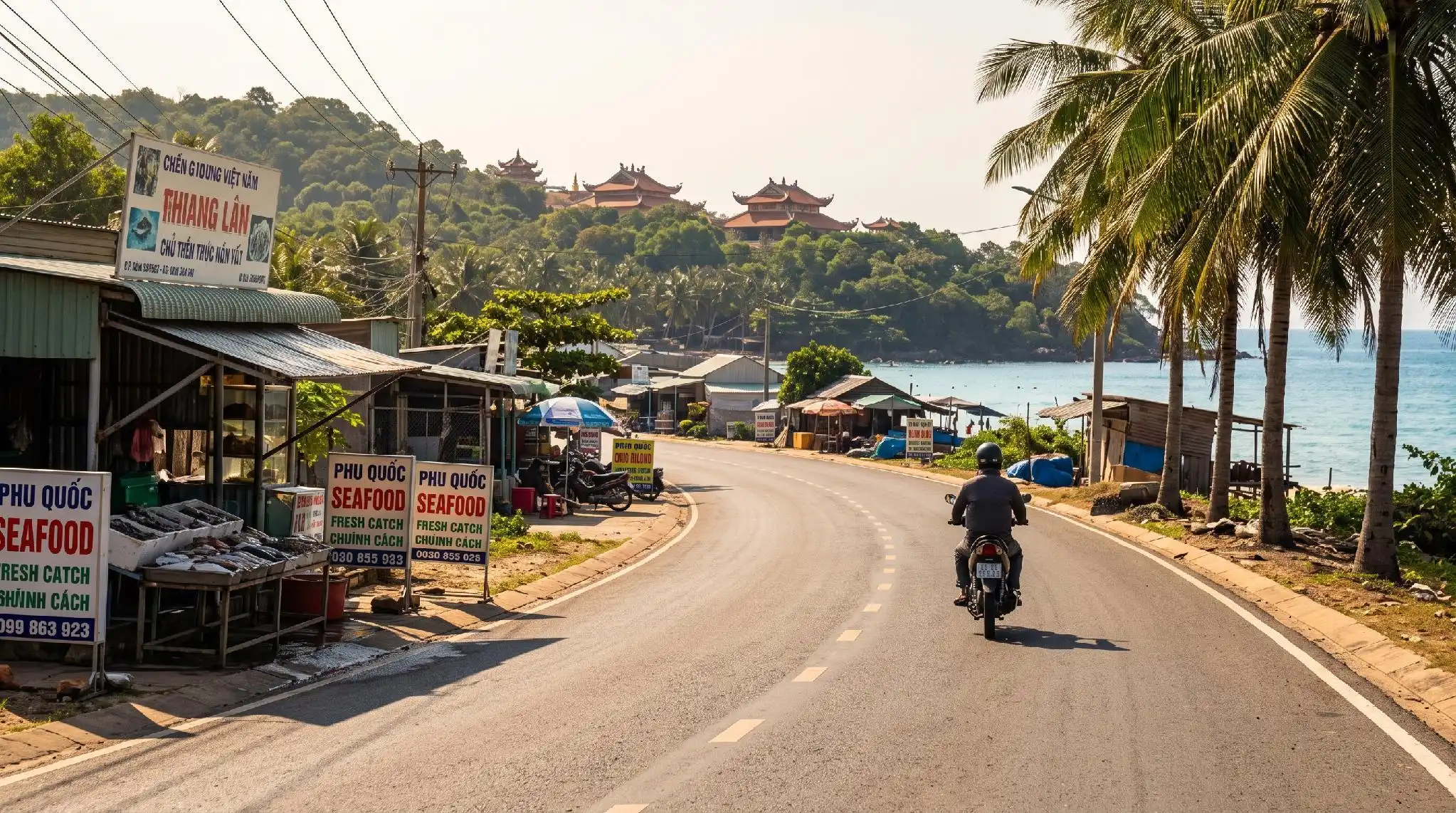
The route runs mostly along a well-paved coastal road, passing several smaller beach communities and roadside seafood stalls before the pagoda’s dragon-scale rooflines come into view on the hillside ahead. Grab taxis and app-based rides both cover this route reliably, and a rental scooter works just as well for anyone comfortable riding on Phu Quoc’s main roads.
From Khem Beach & Southern Phu Quoc
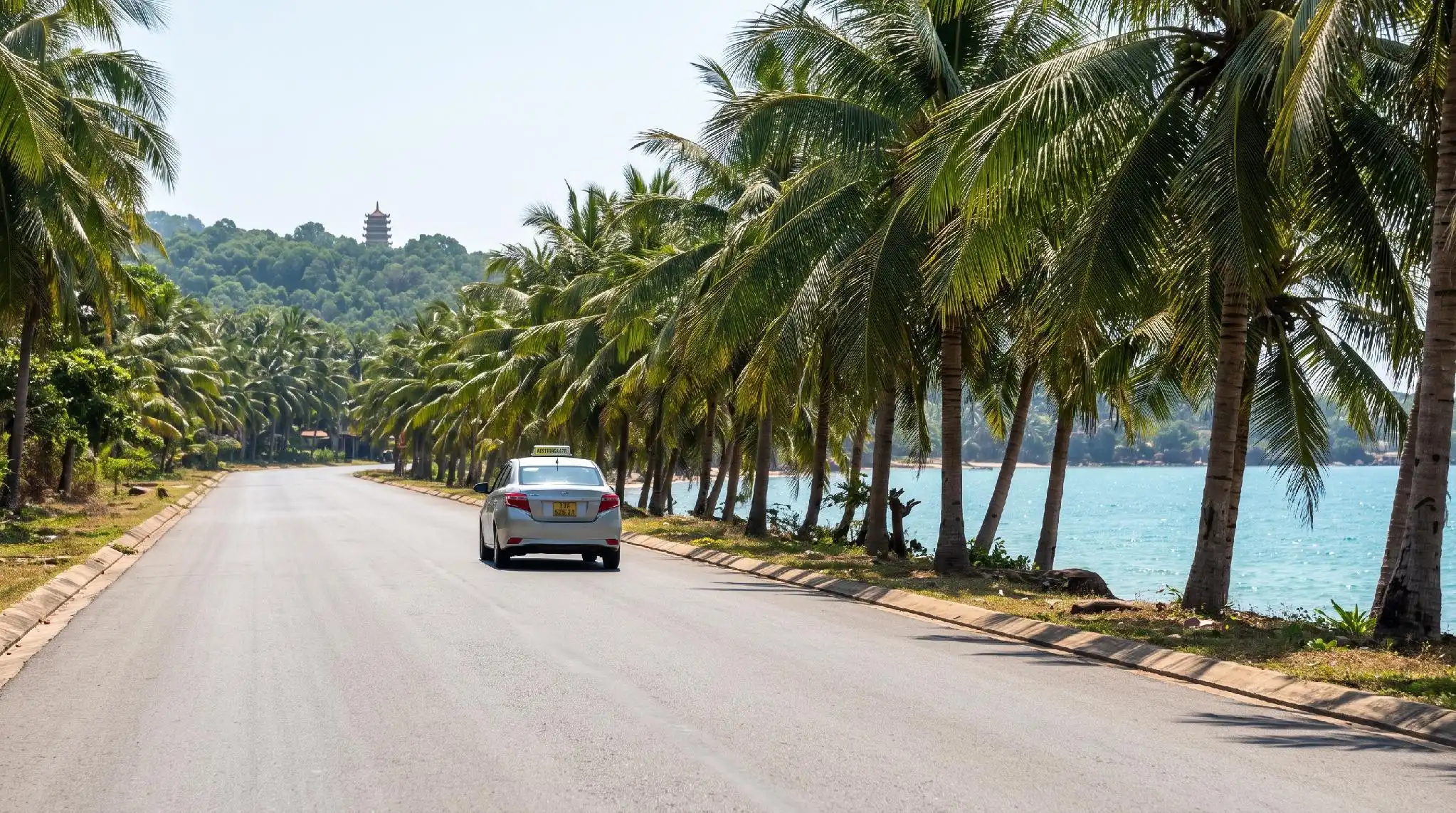
From Khem Beach specifically, Ho Quoc Pagoda sits only about 6 to 7 kilometres away, a genuinely short 15-minute ride by motorbike or taxi along the same southern road. Continuing roughly another 7 kilometres past the pagoda gate reaches An Thoi town, making it entirely realistic to combine a temple visit with other stops on the island’s southern end in a single half-day loop.
Entrance Fee, Opening Hours & What to Wear
Ho Quoc Pagoda charges no entrance fee, open daily from 6:00 in the morning until 6:00 in the evening. A relaxed, unhurried visit runs about one to one and a half hours, enough time to climb the dragon staircase, walk the main courtyard, and reach the sea-facing Guanyin statue without rushing any of it.
As an active working monastery rather than a purely historical site, modest dress matters here. Shoulders and knees should stay covered; a simple t-shirt with trousers, or a longer skirt, covers the requirement without needing to pack anything specific. Free sarongs are available at the entrance for anyone caught in beachwear, though arriving already dressed appropriately is the more respectful option.
- Cover shoulders and knees before entering any of the main halls
- Remove hats inside the temple buildings themselves
- Keep voices low near active prayer areas, even outside of service times
- Ask before photographing monks or anyone actively praying
Weather shapes the visit more than most people expect. The dragon staircase and main courtyard sit fully exposed to the sun, so a mid-morning or late-afternoon visit avoids the harshest midday heat, and the dry season running from November through April offers the most reliable conditions for the open-air sections of the grounds.
Why the free entry and long hours make it easy to fit in
Ho Quoc Pagoda charges no entrance fee and stays open daily from 6:00 in the morning until 6:00 in the evening, a wide window that fits around beach time or other sightseeing.
That flexibility makes it easy to combine with other stops on the same day rather than needing to plan a dedicated outing around it.
The Story & Meaning of Ho Quoc Pagoda
Phu Quoc sits at Vietnam’s maritime edge, closer to Cambodia’s coastline than to the Vietnamese mainland at its narrowest point, and Ho Quoc Pagoda’s name and positioning both trace directly back to that geography. Built explicitly as a spiritual anchor for the country’s border territory, the temple follows the Truc Lam school of Vietnamese Zen Buddhism, a tradition that emphasises meditation and a direct, unadorned relationship with practice over elaborate ritual.
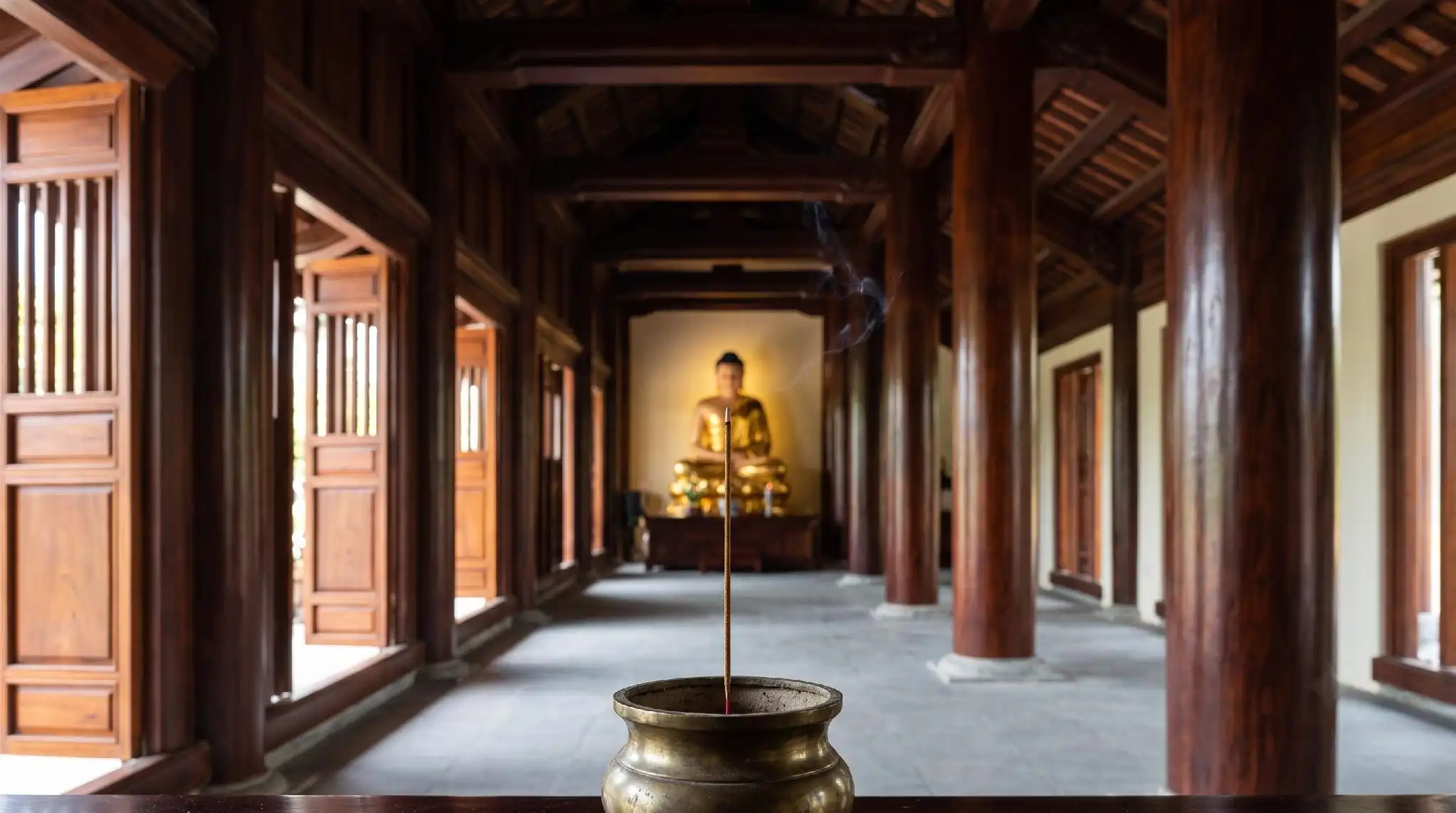
That combination, serious Buddhist practice housed inside one of the most photographed pieces of religious architecture in southern Vietnam, is a large part of why any Phu Quoc pagoda guide worth reading treats Ho Quoc as the obvious starting point rather than one stop among many.
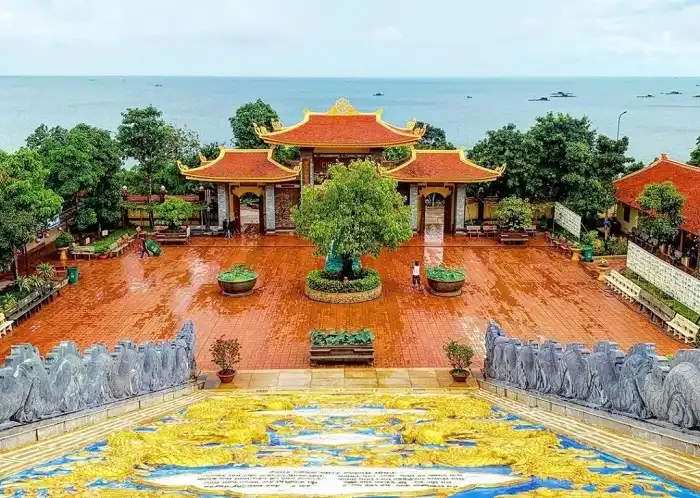
The pagoda also functions as a genuine community anchor, not just a landmark for visiting travelers. Local families bring newborns for a first blessing, couples visit ahead of weddings, and the grounds fill with lay Buddhists during Vu Lan, the Vietnamese Ullambana festival honouring parents and ancestors, each autumn. That everyday role, alongside the architecture, is worth keeping in mind while walking the grounds: this is a working place of worship first and a landmark second.
Why Phu Quoc’s position shapes the pagoda’s meaning
Phu Quoc sits at Vietnam’s maritime edge, at its narrowest point closer to Cambodia’s coastline than to the Vietnamese mainland.
That remote, borderland setting is part of what gives Ho Quoc Pagoda its significance as a spiritual anchor point for the island.
What to See at Ho Quoc Pagoda
The complex rewards a slow walk rather than a quick photo stop, with three distinct features worth building time around specifically. Each sits at a different point along the climb from the entrance gate to the upper courtyard, so seeing all three naturally happens in order rather than requiring any backtracking.
The Dragon Staircase & Triple Gate
Visitors arrive first at the Tam Quan, the traditional three-door gate that opens any major Vietnamese Buddhist temple. Each door carries its own name and meaning: the central Dia Giac gate, flanked by Bat Nha on the left and Giai Thoat on the right, together representing stages of enlightenment a visitor symbolically passes through on the way in.
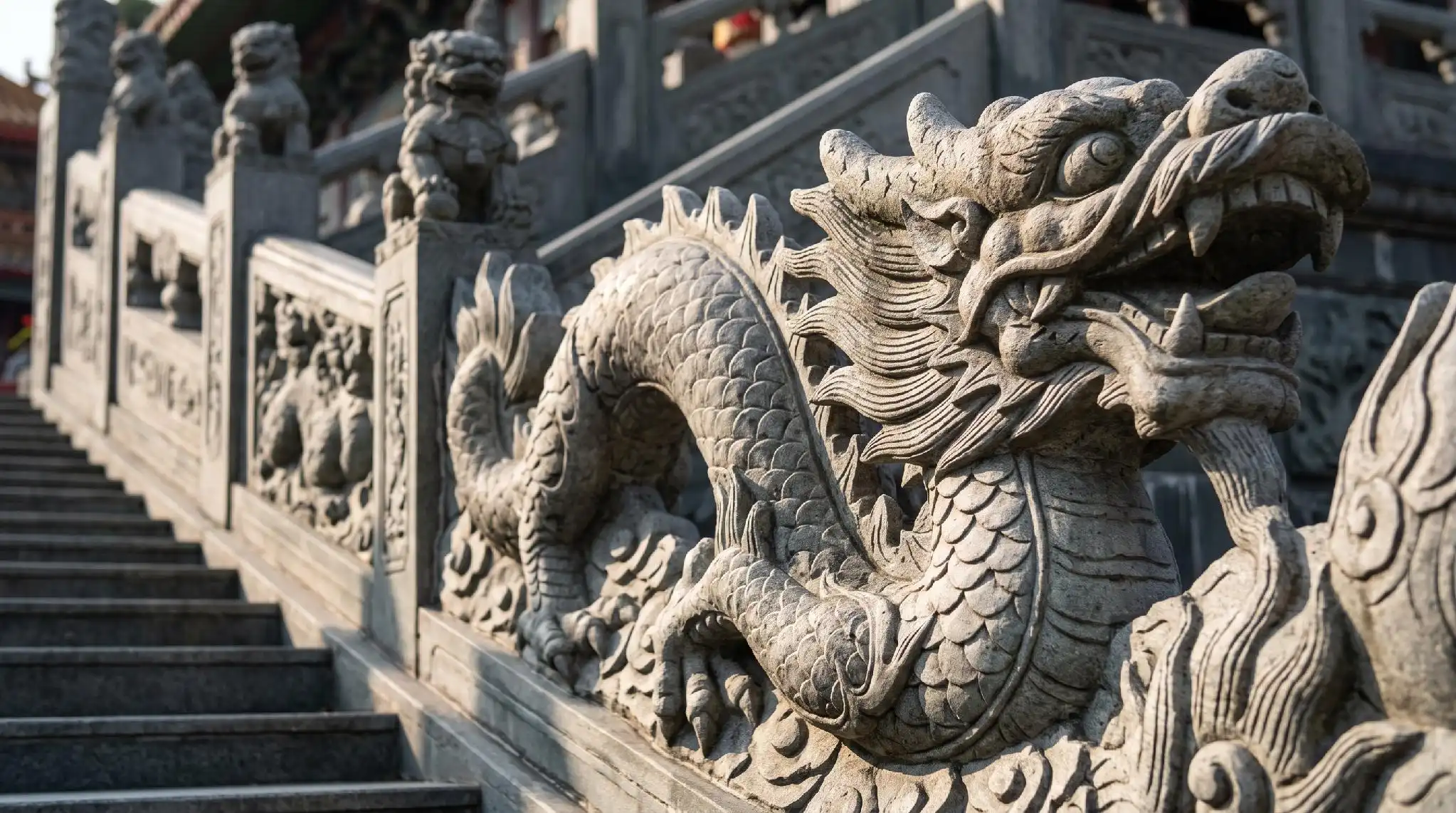
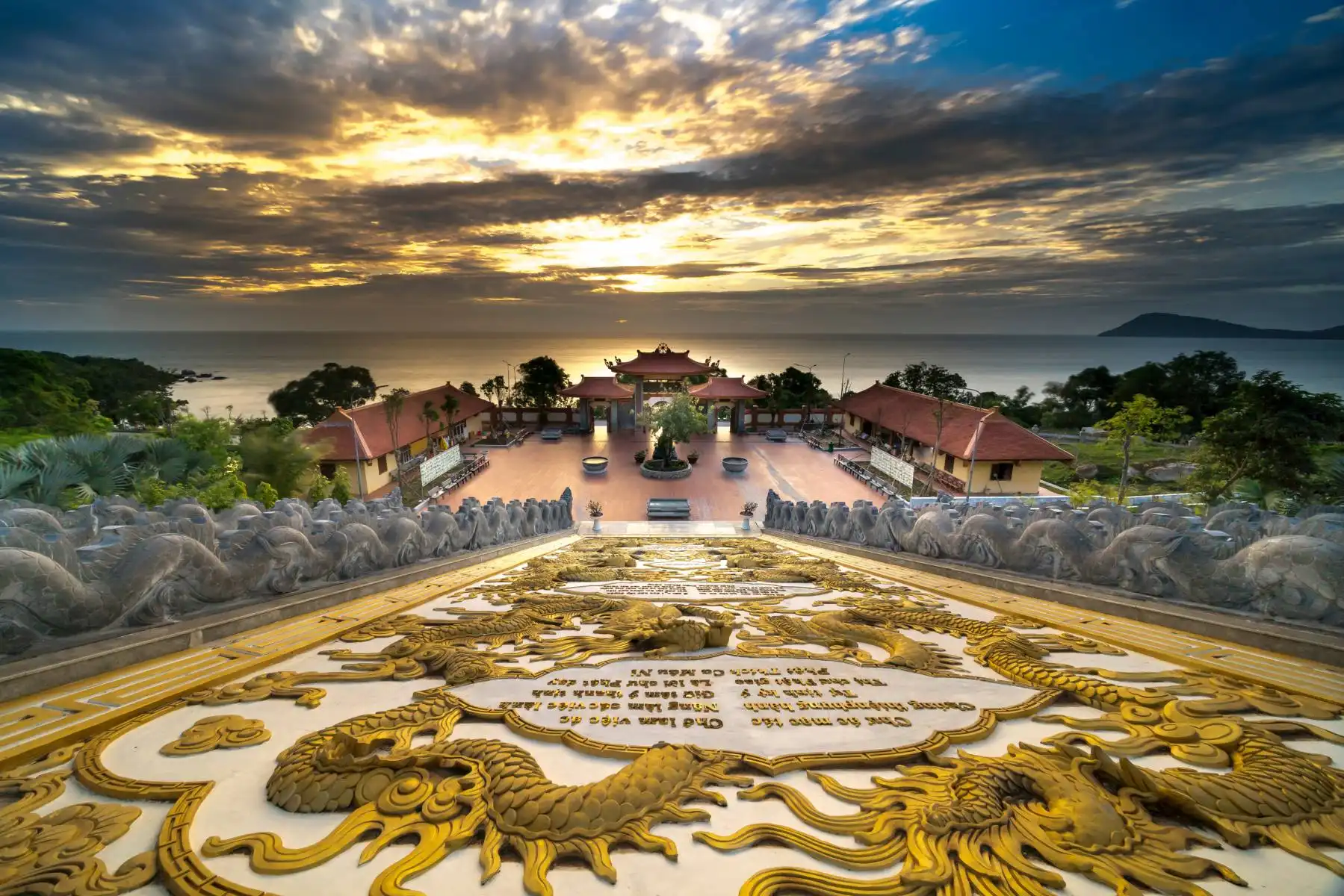
Beyond the gate, more than 70 stone steps climb toward the main courtyard, flanked the entire way by two carved stone dragons that appear to flow down the staircase’s full length. The sheer scale of the carving, easily the most photographed single feature at the pagoda, makes the climb itself part of the experience rather than just a means of reaching the top. Rows of smaller stone figures line sections of the balustrade alongside the dragons, part of the wider decorative program that carries through the rest of the complex.
The Guanyin (Quan Am) Statue & Sea View
At the upper courtyard, a tall white statue of Guanyin, known in Vietnamese as Quan Am, faces out toward the open sea. Guanyin represents compassion in Buddhist tradition, and the statue’s position, framed against open water rather than tucked into an interior hall, is deliberate: a visual reminder of the pagoda’s role watching over the same waters that define the island’s fishing communities and its border position alike.
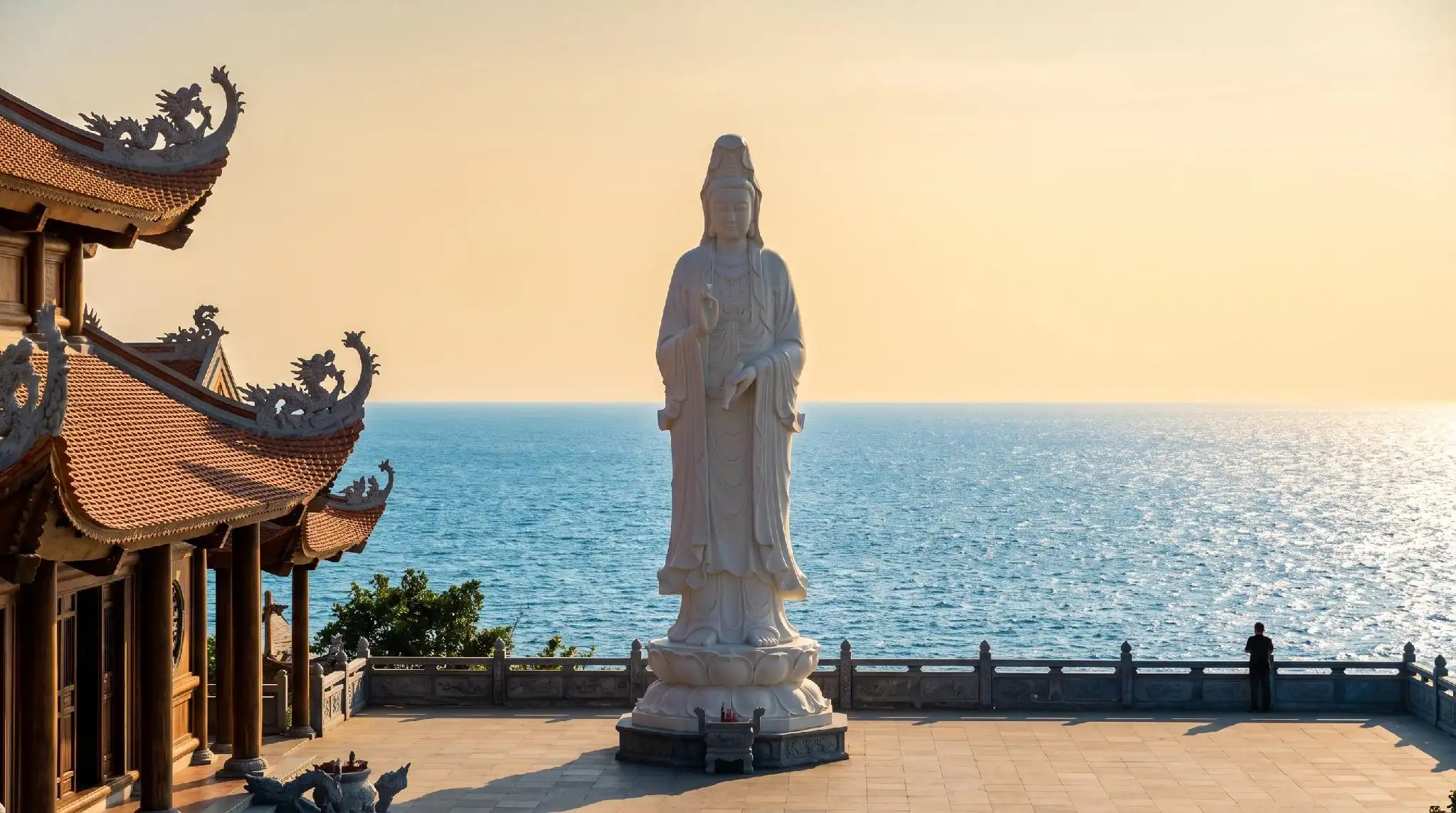
The view from this specific vantage point, sea on one side and the pagoda’s full dragon-scale rooflines on the other, is the single shot that shows up most often in any search for a Phu Quoc pagoda photographed from its best angle. Late afternoon light works best here, softening the white stone of the statue against the water without the harsh glare that builds up by midday.
The Bell & Drum Pavilions
A pair of smaller pavilions flanks the main hall, one housing a large ceremonial bell and the other a matching drum, a standard feature of Vietnamese Buddhist temple architecture used to mark the rhythm of daily prayer sessions. At Ho Quoc specifically, the pavilions’ matching dragon-scale roofs and lim-wood construction tie them visually back to the main hall rather than reading as an afterthought bolted onto the side of the complex.
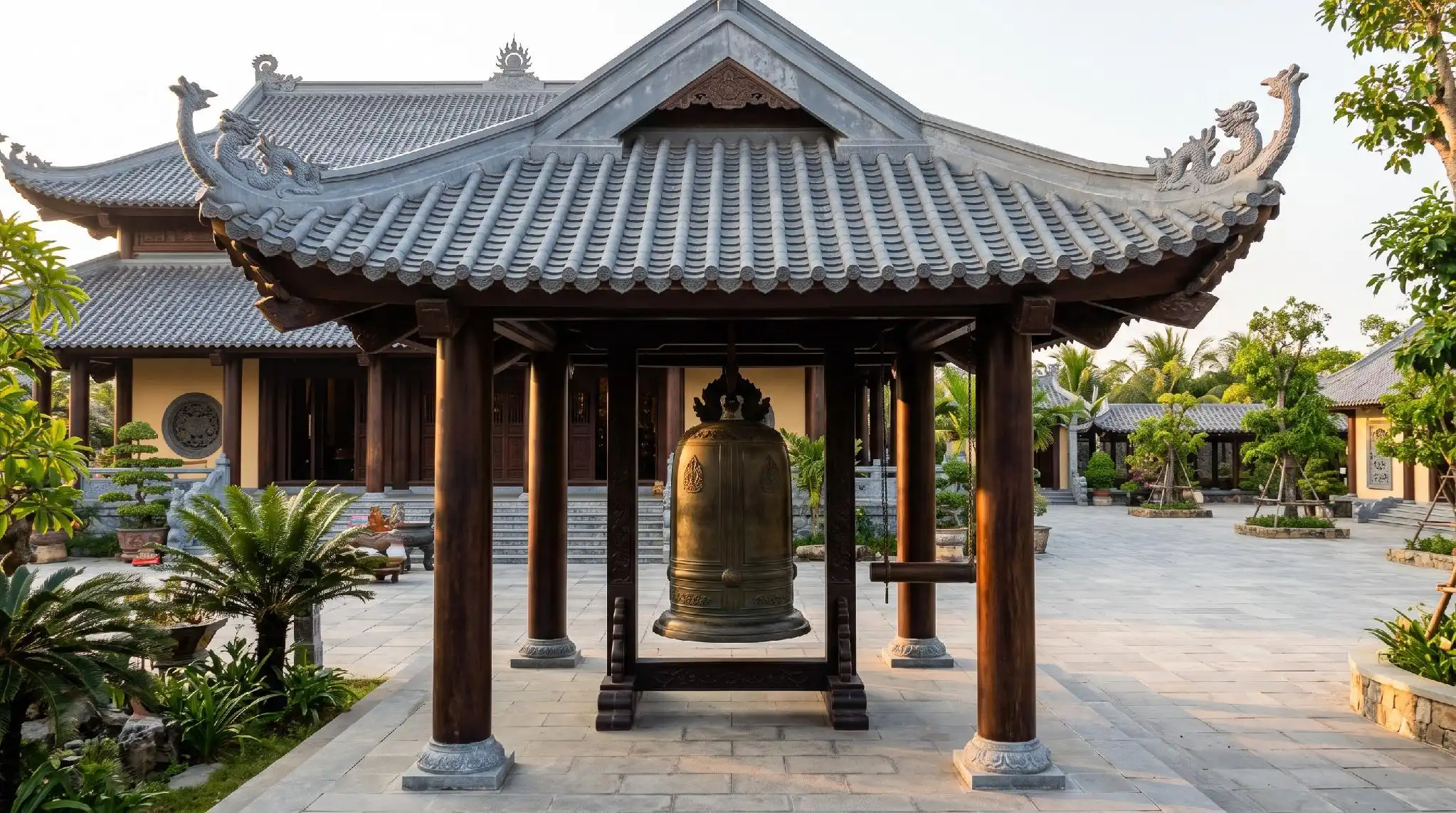
The bell in particular sounds at set points during the day tied to morning and evening chanting sessions, and hearing it roll across the open courtyard, sea visible in the background, is one of the quieter but more memorable moments of a visit here. Visitors who time their walk around these chanting sessions get a genuinely different experience of the pagoda than a purely daytime, photo-focused visit provides.
Other Sacred Sites to Visit in Phu Quoc
Ho Quoc anchors most Phu Quoc pagoda itineraries, but three other sites round out a genuinely fuller picture of the island’s spiritual life, each with a distinct character of its own. None require a special detour on their own, since all three sit within a reasonable loop of Duong Dong town or the island’s southern beach areas.
Dinh Cau Shrine (Duong Dong)
Perched on a rocky outcrop at the mouth of the Duong Dong River, Dinh Cau traces its origins back to the 17th century, among the oldest spiritual sites anywhere on the island.
The shrine is dedicated to Thien Hau, the Sea Goddess credited with protecting fishermen and sailors, and local boat crews still stop to burn incense here before heading out to open water. A functioning lighthouse shares the same rocky platform, and the spot doubles as one of Duong Dong’s most popular sunset viewpoints, worth timing a visit around the late afternoon specifically.
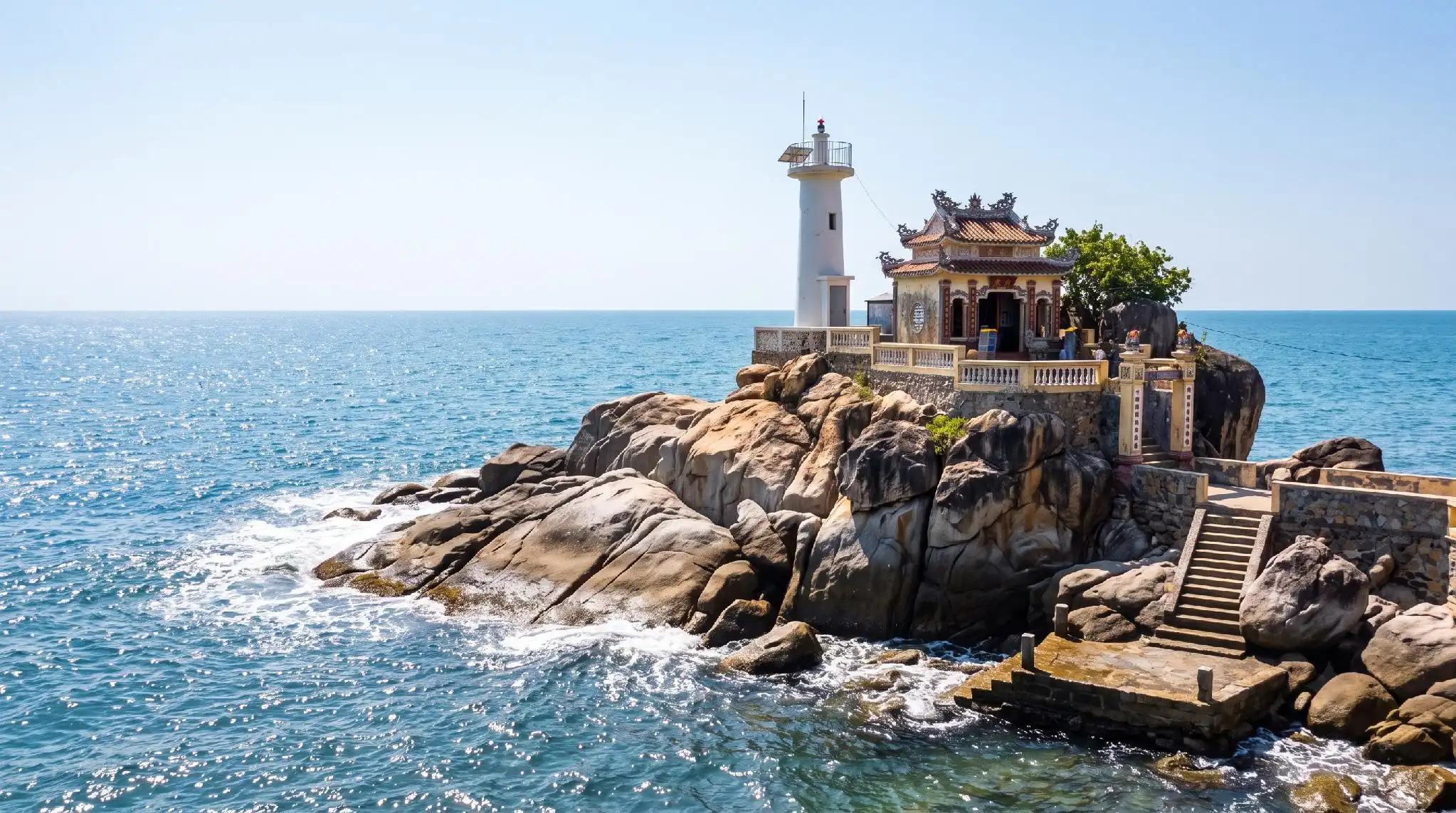
The rocks below the shrine are worn smooth from generations of foot traffic, and a short flight of stairs leads down to a small platform right at the waterline for anyone who wants a closer look at the tide moving through the river mouth. Vendors selling grilled seafood and drinks line the walkway leading up to the shrine most evenings, making it as much a local gathering spot as a place of worship once the sun starts to drop.
Unlike Ho Quoc Pagoda, which sits apart from the town on its own hillside grounds, Dinh Cau is woven directly into daily life in Duong Dong. It works well as a short evening stop after a full day out at Ho Quoc, rather than a separate outing of its own, especially for anyone staying on the southern half of the island where a single evening trip into town can easily cover both a sunset and dinner.
Detailed Information:
- Address: 6 Bach Dang Street, Duong Dong, Phu Quoc Special Zone, An Giang Province.
- Opening Hours: 7:00 to 20:30 daily.
- Entrance Fee: Free.
Sung Hung Pagoda
Formed in the late 19th century from the merger of two smaller pagodas, Sung Nghia and Hung Nhan, Sung Hung holds the title of the island’s oldest pagoda. French colonial records from 1906 already describe it as the only pagoda serving Duong Dong’s Vietnamese, Hoa, and Minh Huong communities at the time.
Major renovations followed in 1924 and again in 1960, and during the resistance wars against France and the United States, the pagoda quietly served as a covert contact point for revolutionary fighters. It sits at 7 Tran Hung Dao Street, roughly 1.5 kilometres from the Phu Quoc Night Market, an easy add-on to an evening market visit.
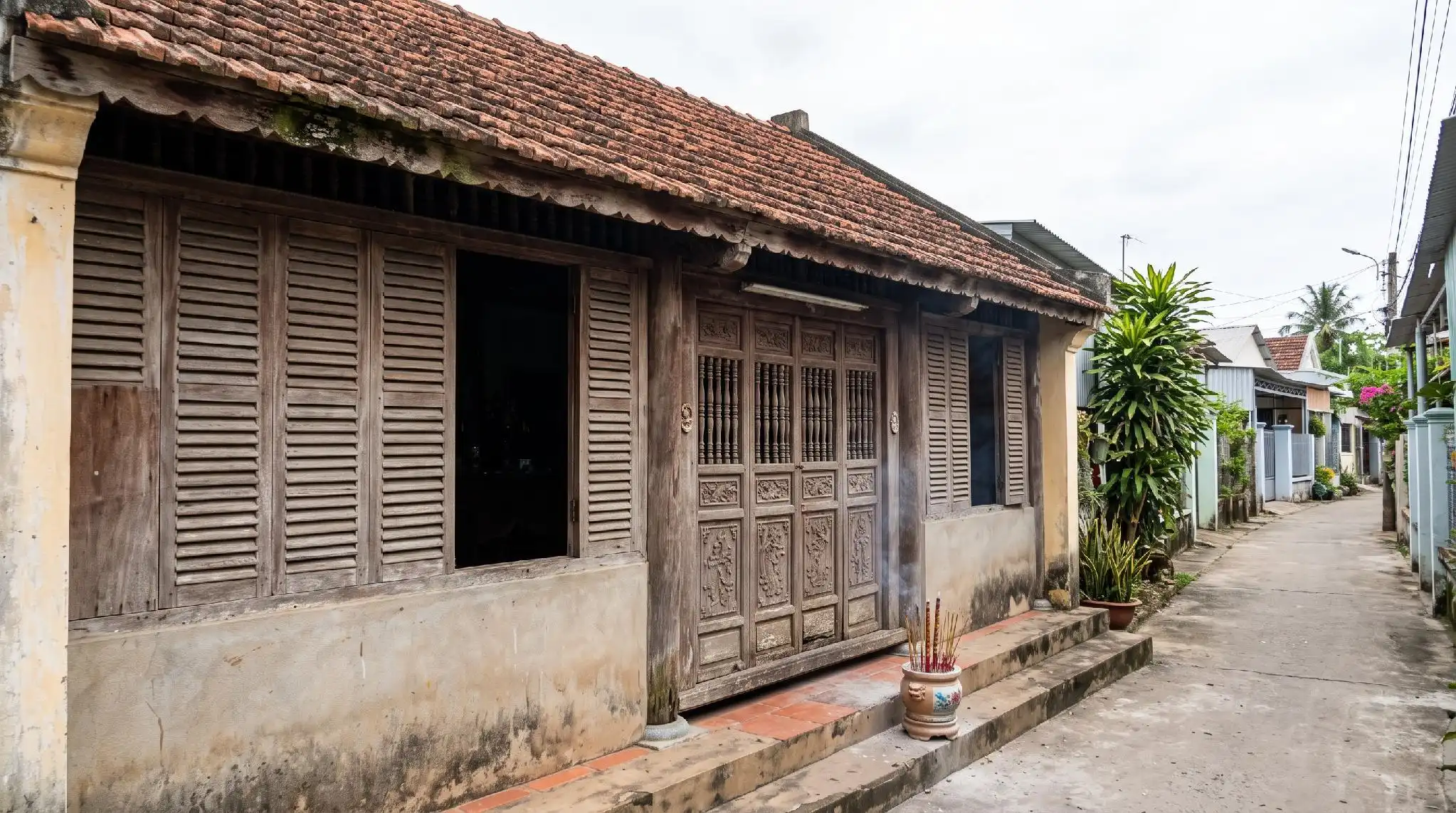
Compared with Ho Quoc’s scale, Sung Hung is modest and unhurried, a single-hall layout with a weathered, lived-in feel that reflects over a century of continuous use rather than a recent build.
That contrast is part of what makes the two worth pairing on the same day: one shows the island’s newest major Phu Quoc pagoda, the other its oldest. Incense smoke, worn wooden beams, and faded murals inside the main hall all point to a building that has stayed in continuous daily use rather than being restored purely for visitors.
Detailed Information:
- Address: 7 Tran Hung Dao Street, Duong Dong, Phu Quoc Special Zone, An Giang Province.
- Opening Hours: 7:00 to 18:00 daily.
- Entrance Fee: Free.
Nguyen Trung Truc Temple
Out at Ganh Dau on the island’s northwestern tip, this temple honours a genuine national hero: a resistance leader who fought against French colonial rule through the 1860s. The current building dates to 1993, funded through local community contributions, and was recognised as a Provincial Historical and Cultural Site in 2011 before reopening to the public on 30 October 2016 following a full refurbishment.
It is a further drive from most of the island’s beach areas than Ho Quoc or Dinh Cau, but the historical weight of the site makes it worth the trip for anyone specifically interested in Vietnam’s colonial-era resistance history rather than purely religious architecture.
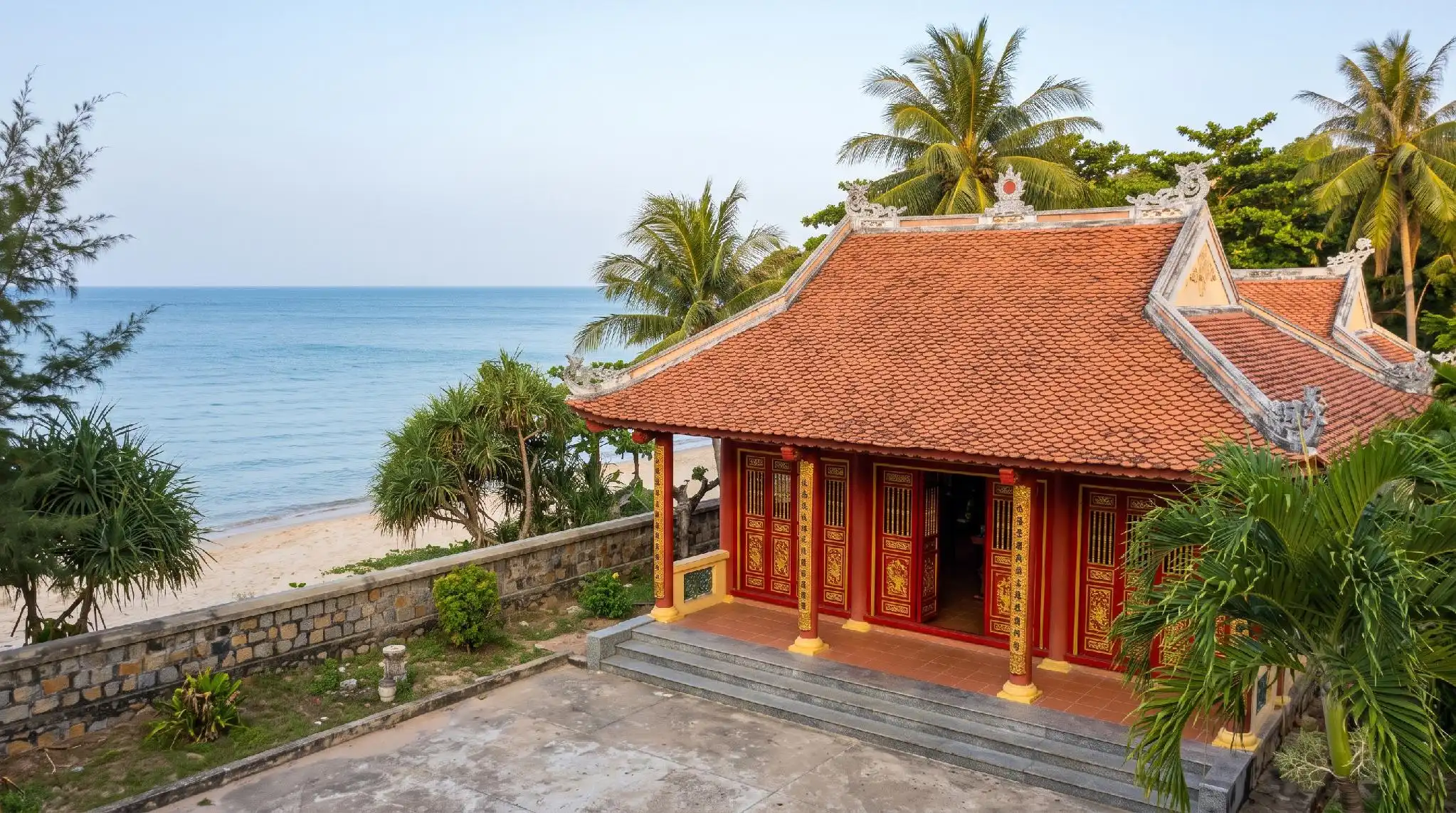
Ganh Dau itself sits close to Phu Quoc’s northern coastline, within sight of Cambodia on a clear day, which adds a genuine sense of place to a temple built specifically to honour a fight against foreign occupation. Combining the visit with Ganh Dau’s own quiet beach makes the long drive out feel worthwhile beyond the temple alone, and the round trip from the southern half of the island is realistic as a dedicated half-day outing rather than a quick add-on to another stop.
Detailed Information:
- Address: Suoi Cai – Ganh Dau Road (DT45), Ganh Dau, Phu Quoc Special Zone, An Giang Province.
- Opening Hours: 7:00 to 18:00 daily.
- Entrance Fee: Free.
The table below lines up all four sites covered in this guide, useful for planning a temple-hopping route in a single glance.
| Site | Distance from Khem Beach | Founded | Highlight |
|---|---|---|---|
| Ho Quoc Pagoda | 6-7 km (about 15 min) | 2011-2012 | Dragon staircase, Guanyin statue over the sea |
| Dinh Cau Shrine | About 20 km (30-40 min) | 17th century | Sea Goddess worship, sunset viewpoint |
| Sung Hung Pagoda | About 21 km (35-40 min) | Late 19th century | The island’s oldest pagoda |
| Nguyen Trung Truc Temple | About 35 km (50-60 min) | 1993 (rebuilt) | National resistance hero memorial |
Making a Temple Day Trip From Khem Beach
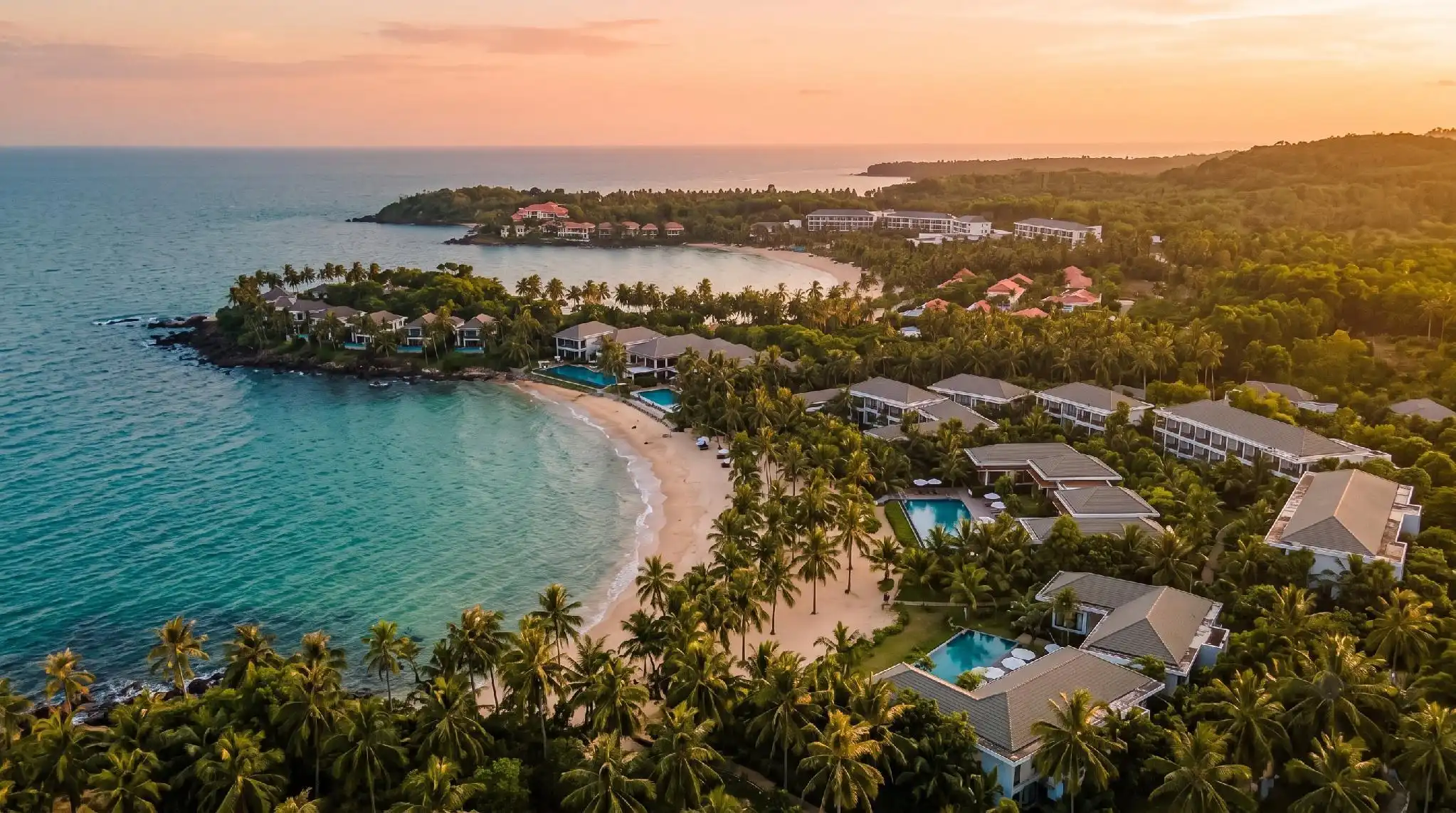
Khem Beach’s southern position puts Ho Quoc Pagoda within the shortest reach of any beach base on the island, which makes it a genuinely practical starting point for a half or full-day temple loop. Staying nearby also means the day can end back on the sand rather than fighting traffic across the island after dark.
Read more: 21 Things to Do in Phu Quoc: Amazing Attractions and Activities
Premier Residences Phu Quoc Emerald Bay
Premier Residences Phu Quoc Emerald Bay sits directly on Khem Beach, putting Ho Quoc Pagoda’s 15-minute drive within easy reach of a morning departure without needing to cross the island first. The resort holds the 2025 TripAdvisor Travelers’ Choice Award, a useful signal of consistency for anyone weighing a temple-day base against other options on the island.
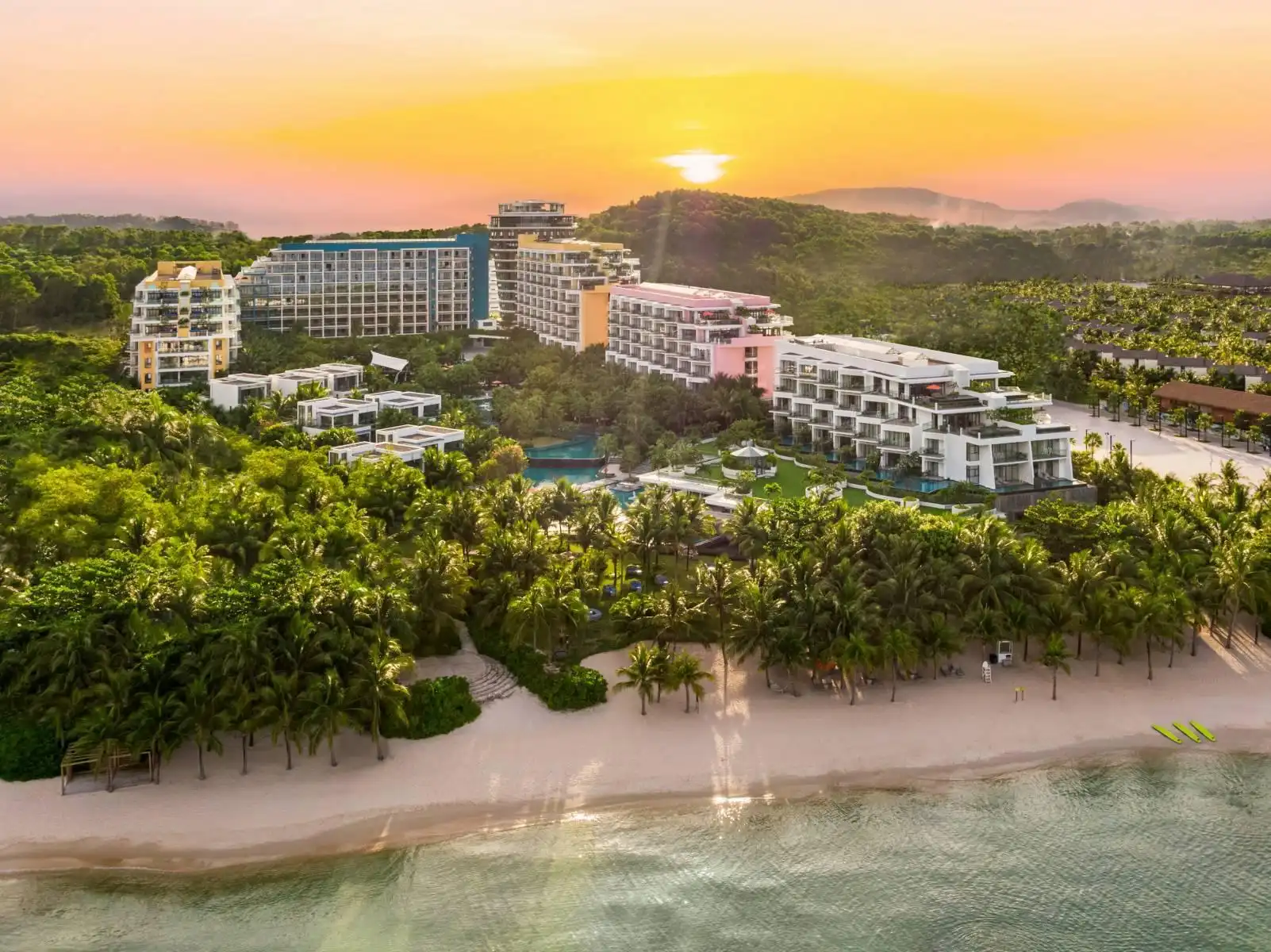
The resort’s concierge can help put together a same-day route covering Ho Quoc Pagoda and Dinh Cau Shrine together, since both sit on a genuinely workable loop from the southern end of the island, and can arrange an on-demand transfer for guests who would rather not self-drive or negotiate a taxi fare on the day.
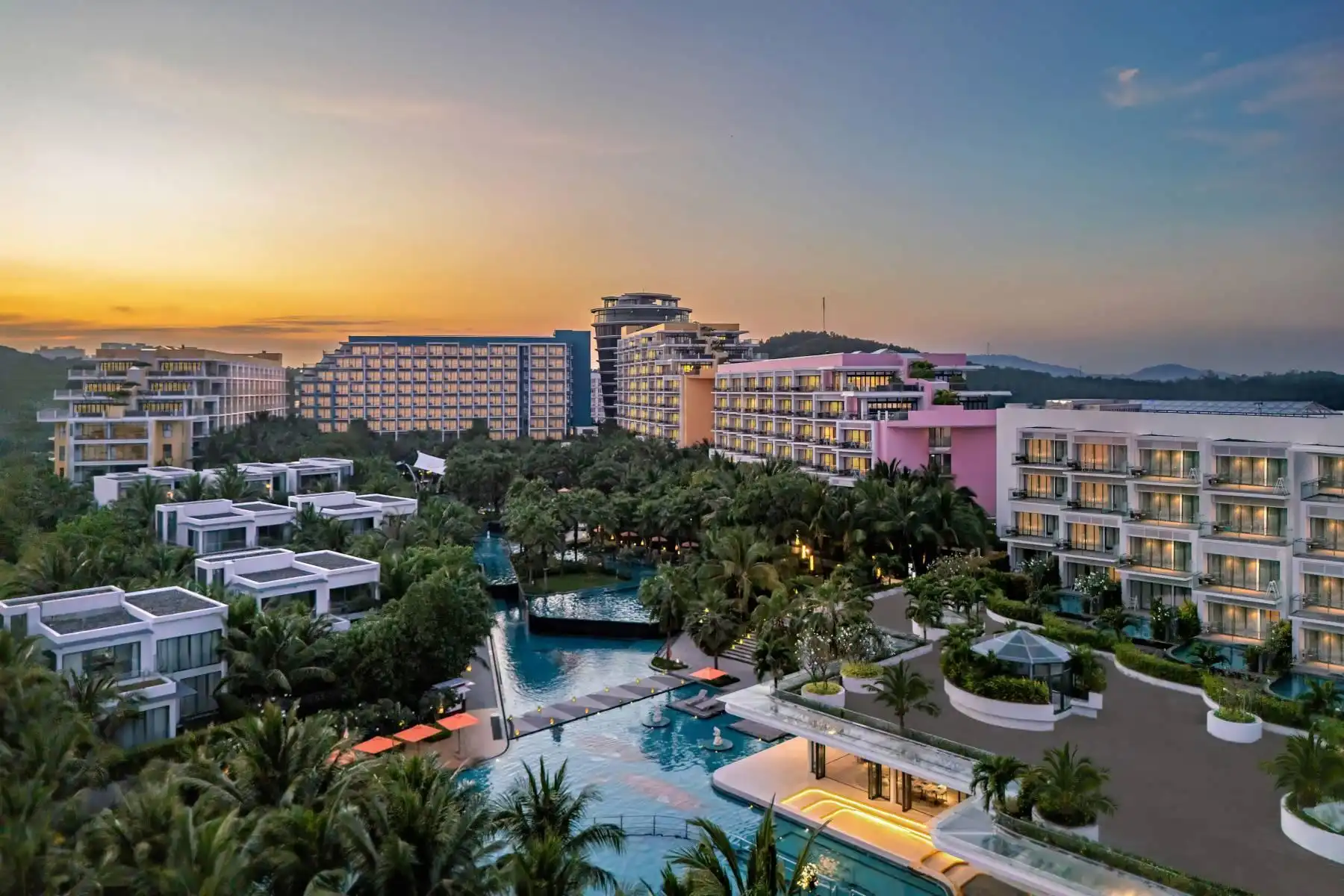
For a full temple day out of Ho Quoc, Dinh Cau, and Sung Hung together, a car and driver booked through the resort removes the friction of arranging separate rides between three spread-out sites.
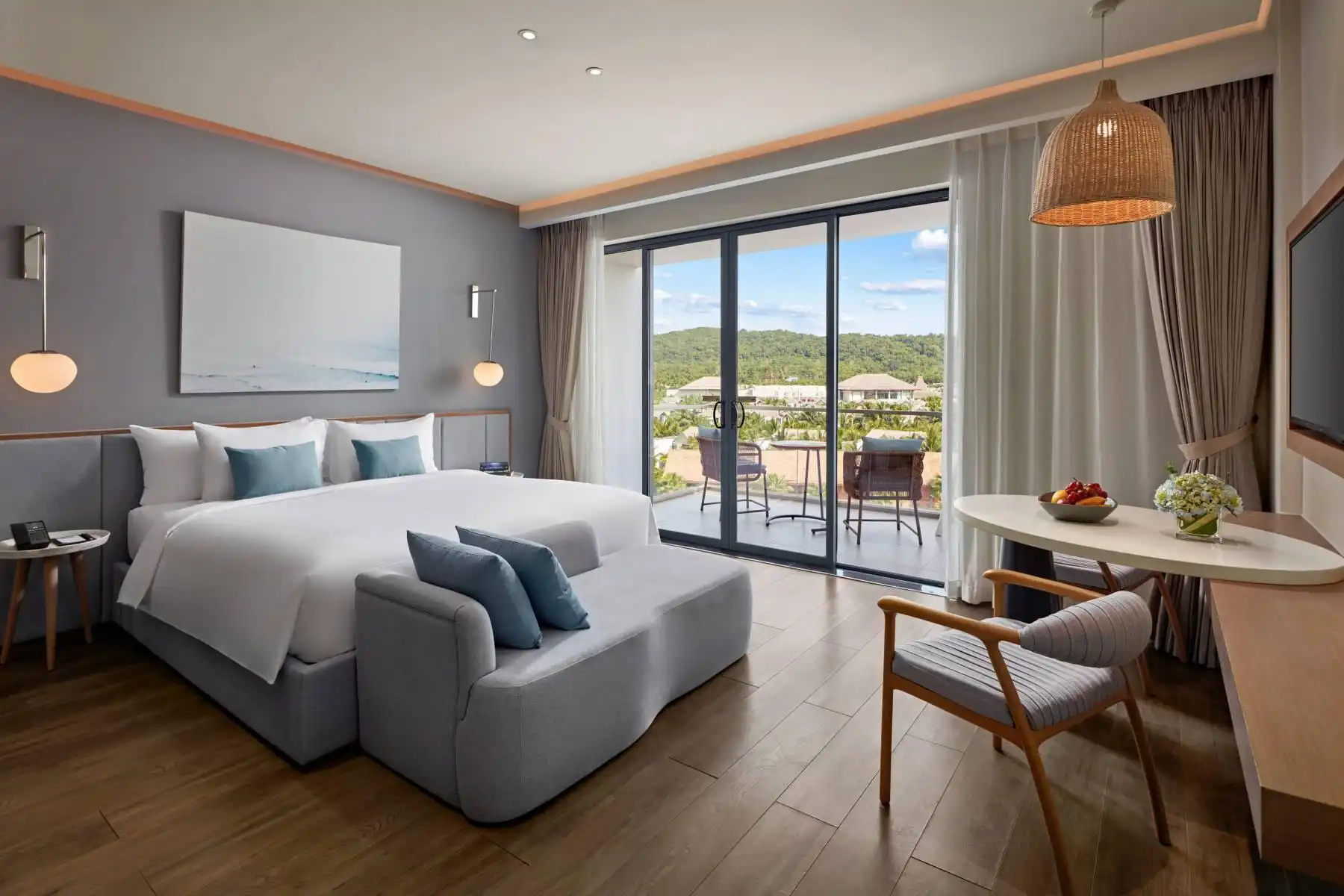
A couple splitting the day between temples and the beach fits comfortably in the Standard Room with Balcony, 45 sqm with a single king bed, a straightforward base for a trip built mostly around sightseeing rather than lounging in the room.
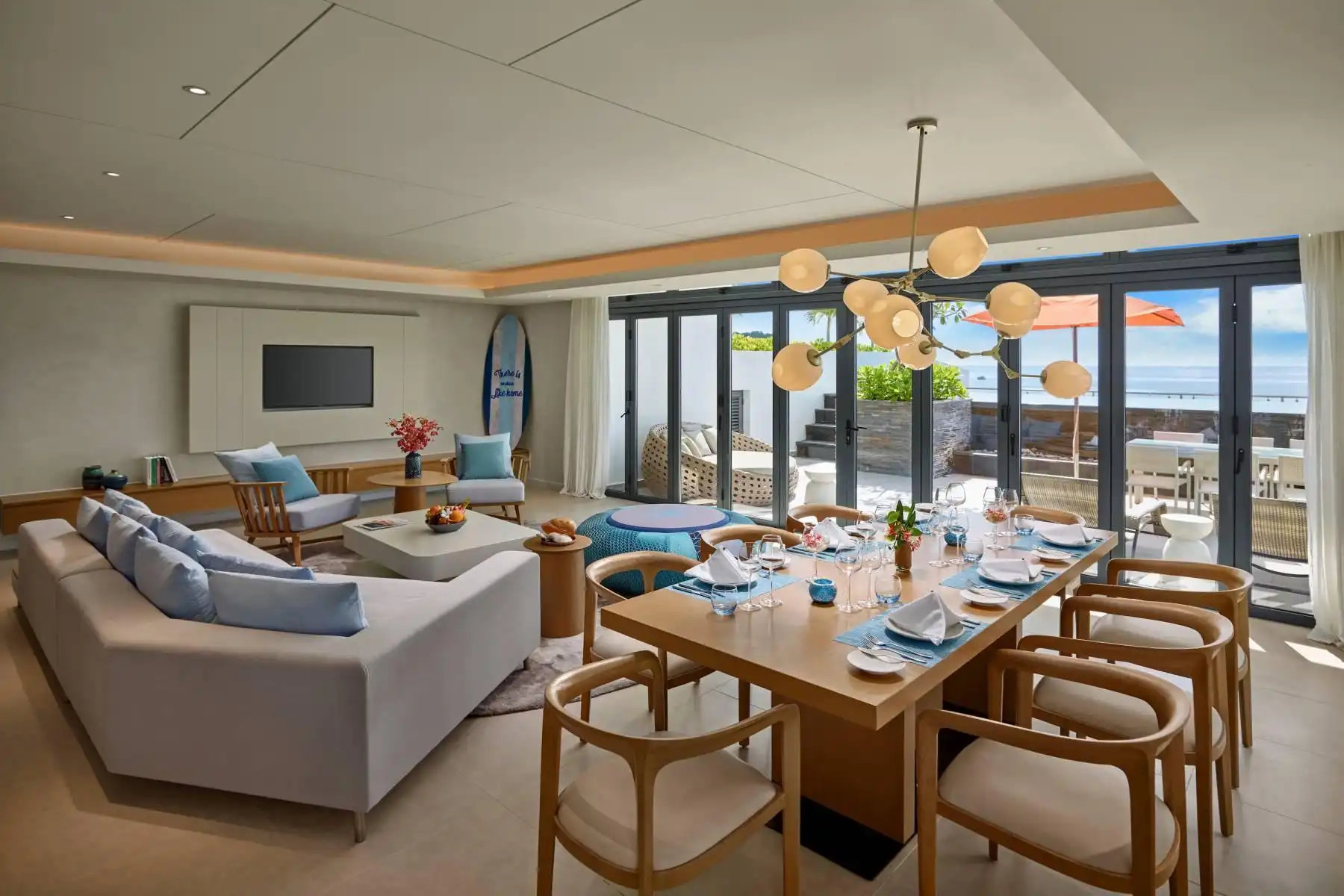
For a group wanting an elevated perspective and extra room to spread out after a long day of temple-hopping, the Penthouse 2 Bedrooms with Private Pool ranges from 135 to 200 sqm, always set on the resort’s top floors, with a private pool of its own for a proper reward once the stone staircases are behind you.

Mercato Restaurant covers breakfast each morning from 6:30 to 10:30 with a Vietnamese and International buffet for in-house guests, a practical way to fuel up before a half-day of walking and stair-climbing at Ho Quoc specifically.
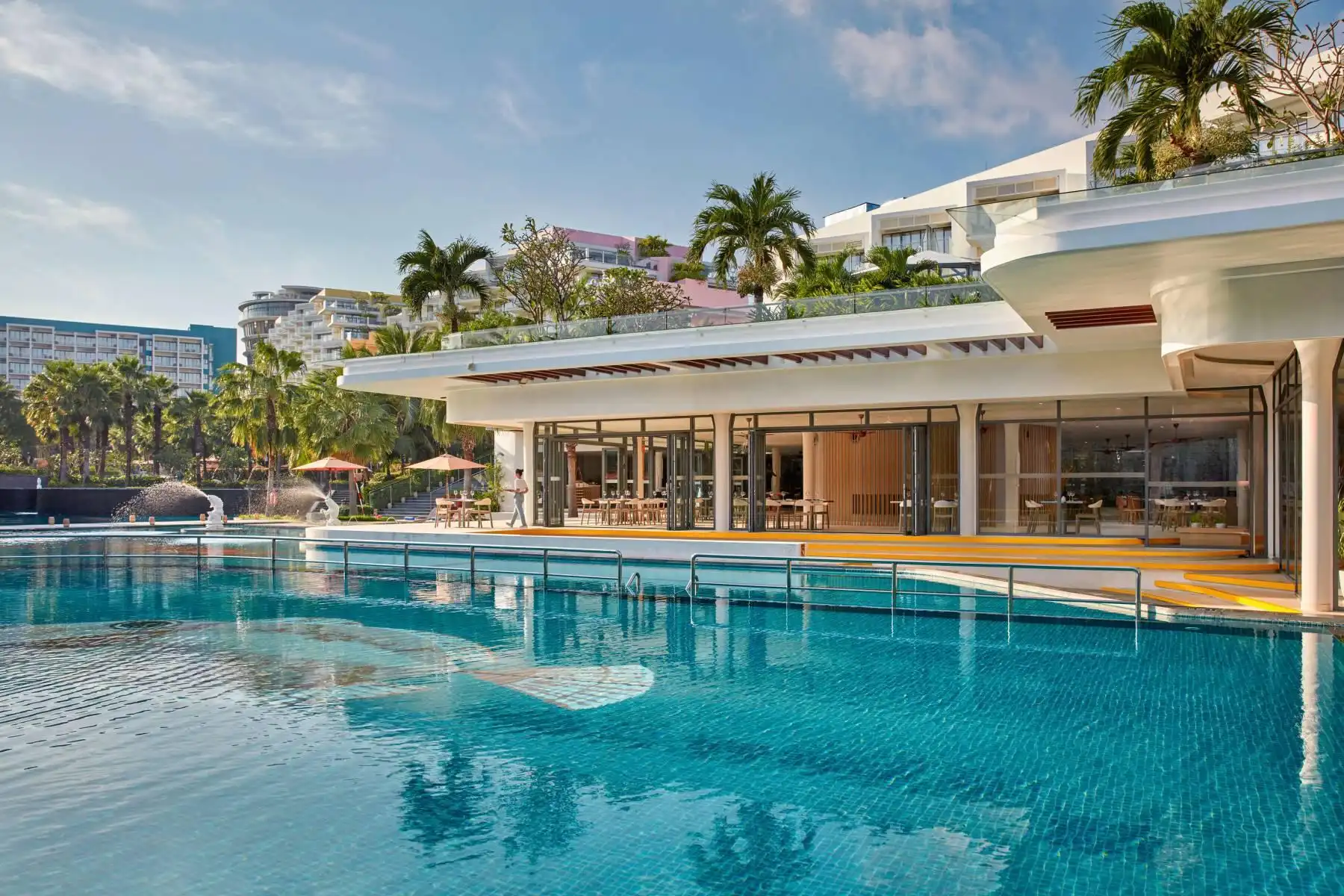
Clubhouse seats up to 350 and runs from 10:00 to 23:00 with last orders at 22:30, its a la carte menu pairing Phu Quoc seafood with European technique alongside a Lunch Buffet from 11:30 to 14:30 and a Dinner Buffet from 18:00 to 21:00.
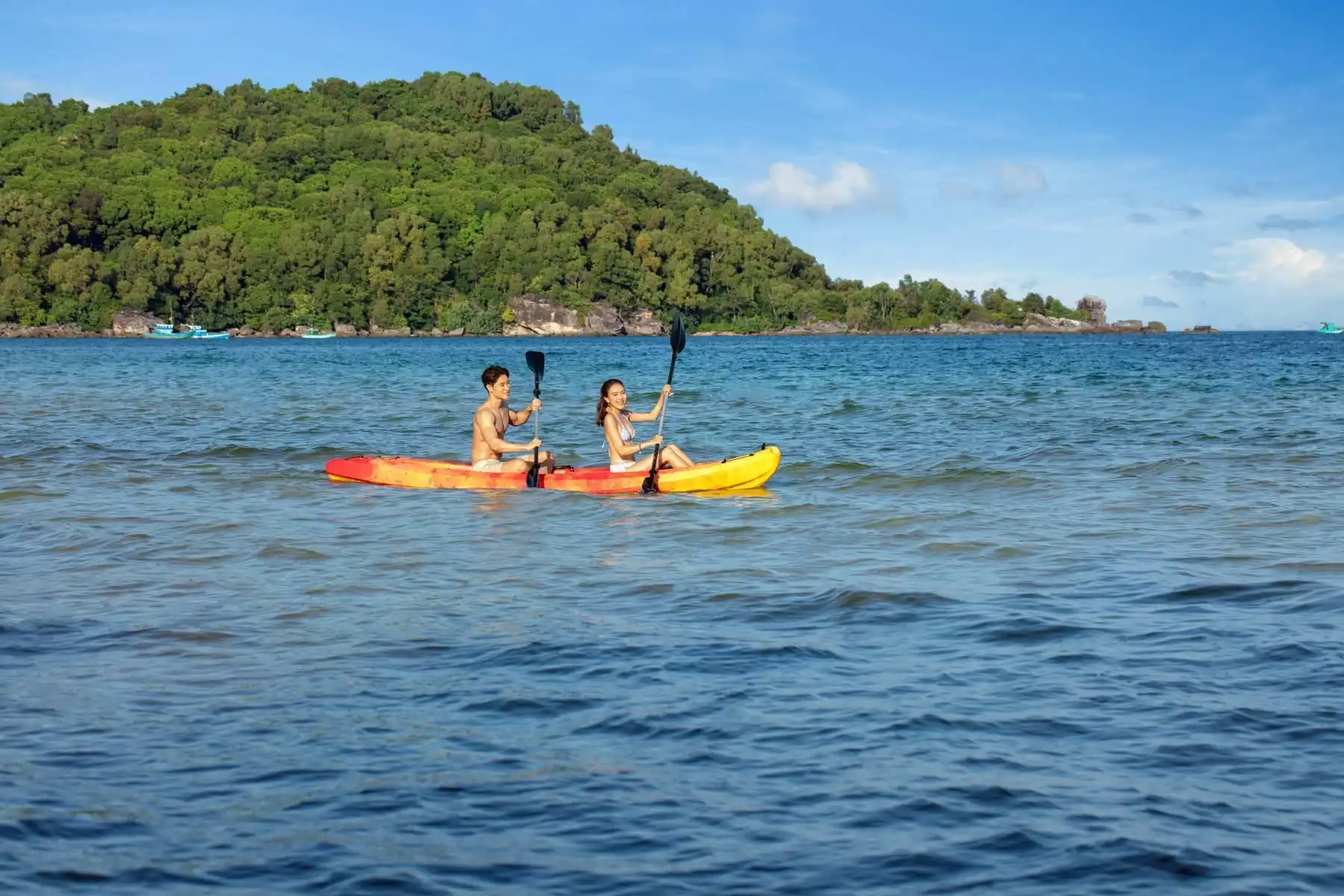
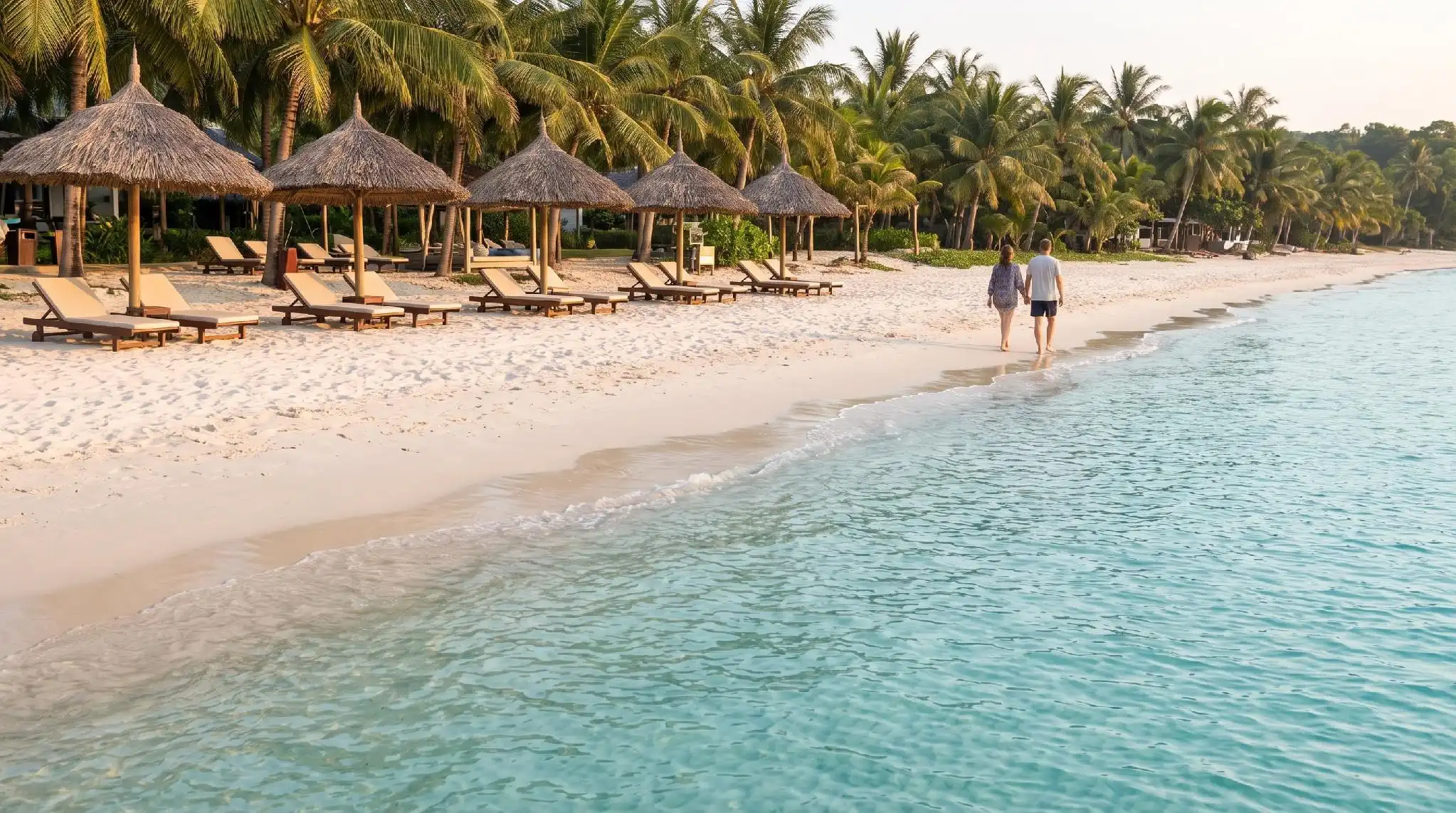
Before heading out to the temples, a morning swim or a complimentary kayak session on Khem Beach itself is worth the early start. Khem Beach was named among the world’s 50 most beautiful beaches by Flight Network in 2018, and its calm, sheltered water makes kayaking genuinely approachable even for a guest who has never paddled before.
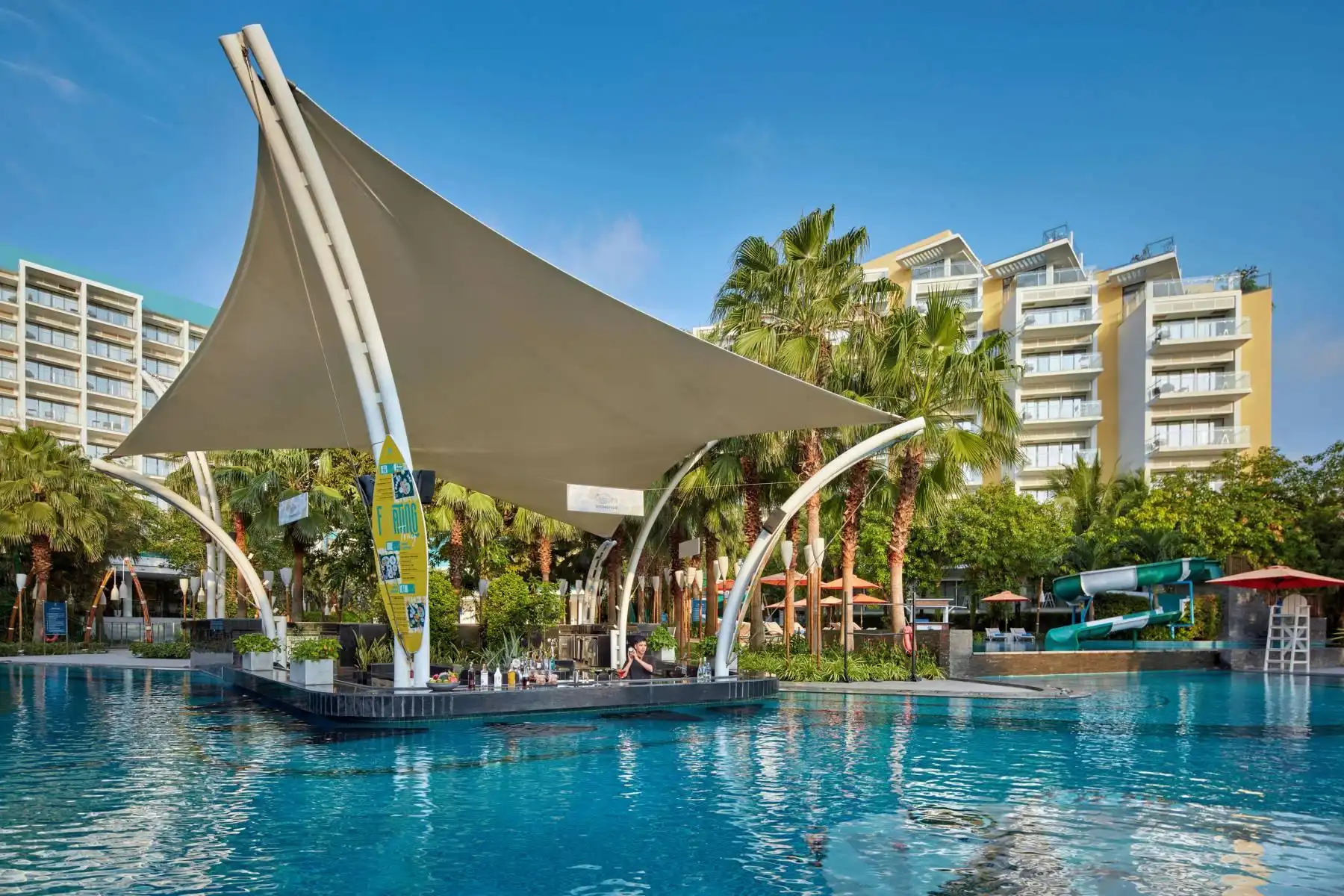
Back from the temple loop in the early afternoon heat, Pool Bar sits right inside the resort’s infinity pool, open daily from 14:00 to 18:00, with a floating service model that brings drinks out to guests still in the water rather than requiring a trip to a bar counter. A skilled bartender runs an extensive cocktail list here, a genuinely different way to cool down than heading straight to a beach bar after a morning spent climbing stone staircases in the sun.
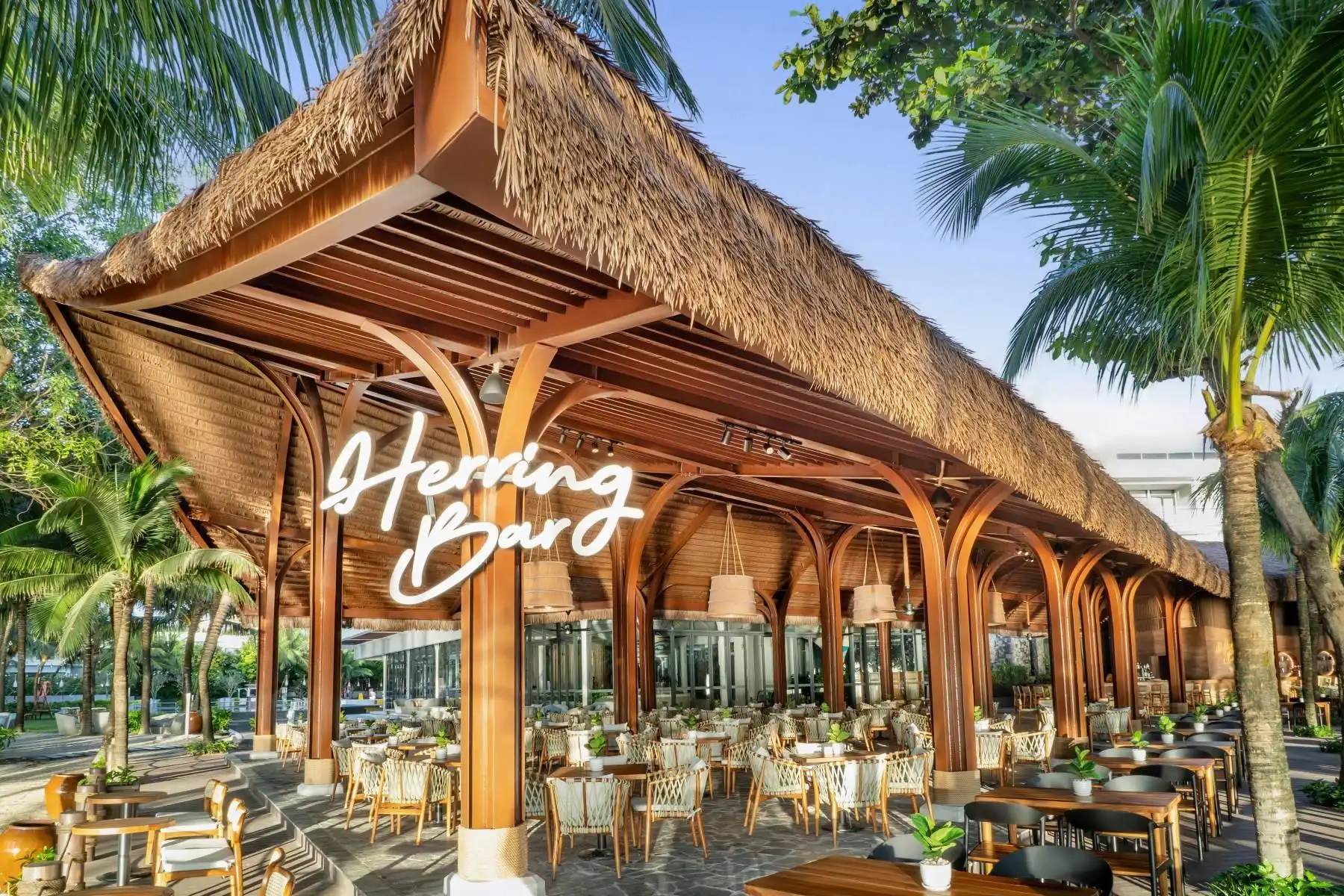
Herring Bar turns Phu Quoc street food into proper bar plates right on the sand at Khem Beach, open from 10:00 to 23:00 with last food orders at 22:30, its open-air layout blending a traditional fishing-village feel with modern coastal design across a genuinely spacious seating capacity of up to 300.
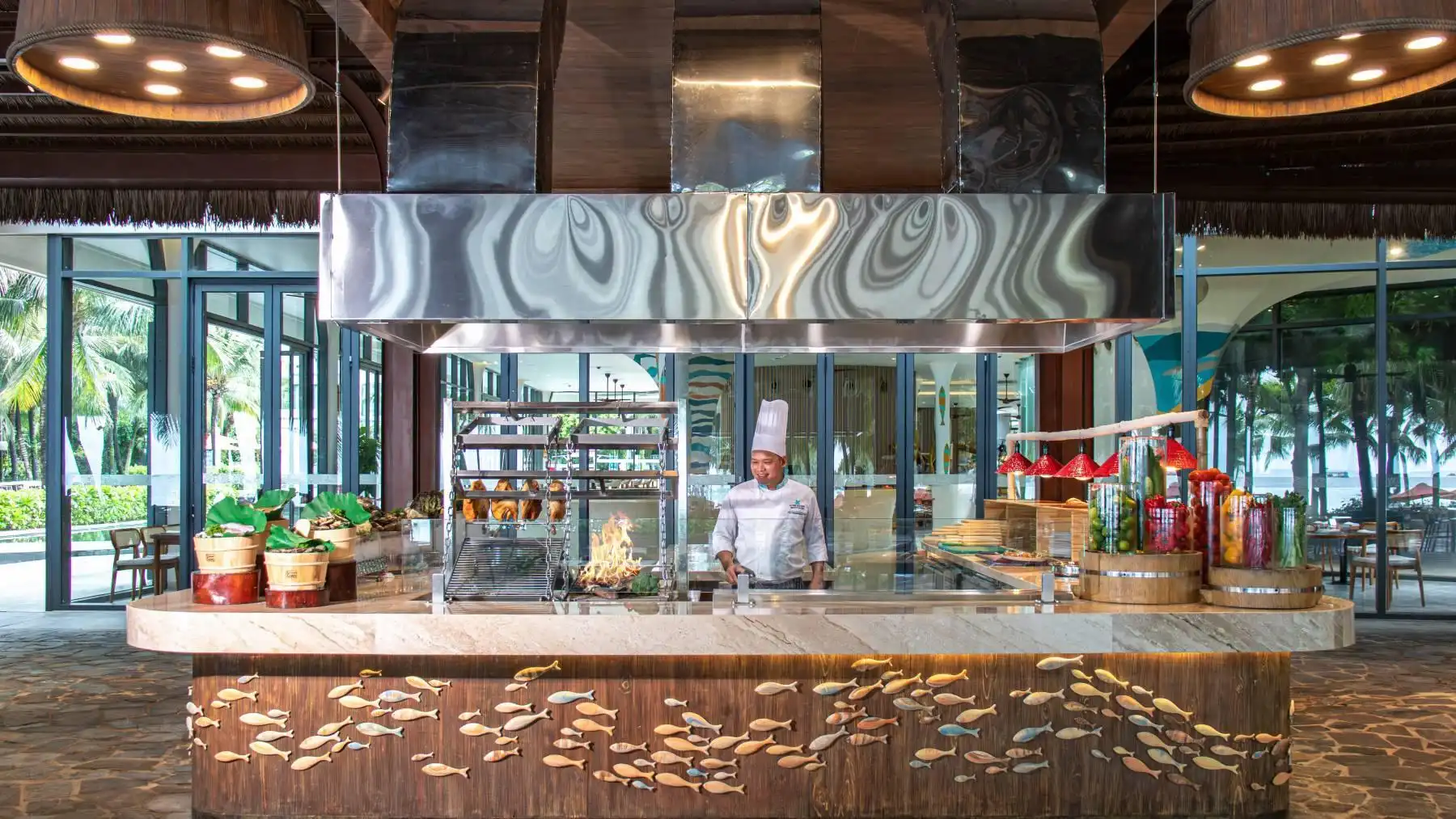
A live BBQ station sits at the centre of the space, chefs grilling seafood and meat over charcoal in full view rather than out of sight in a back kitchen.
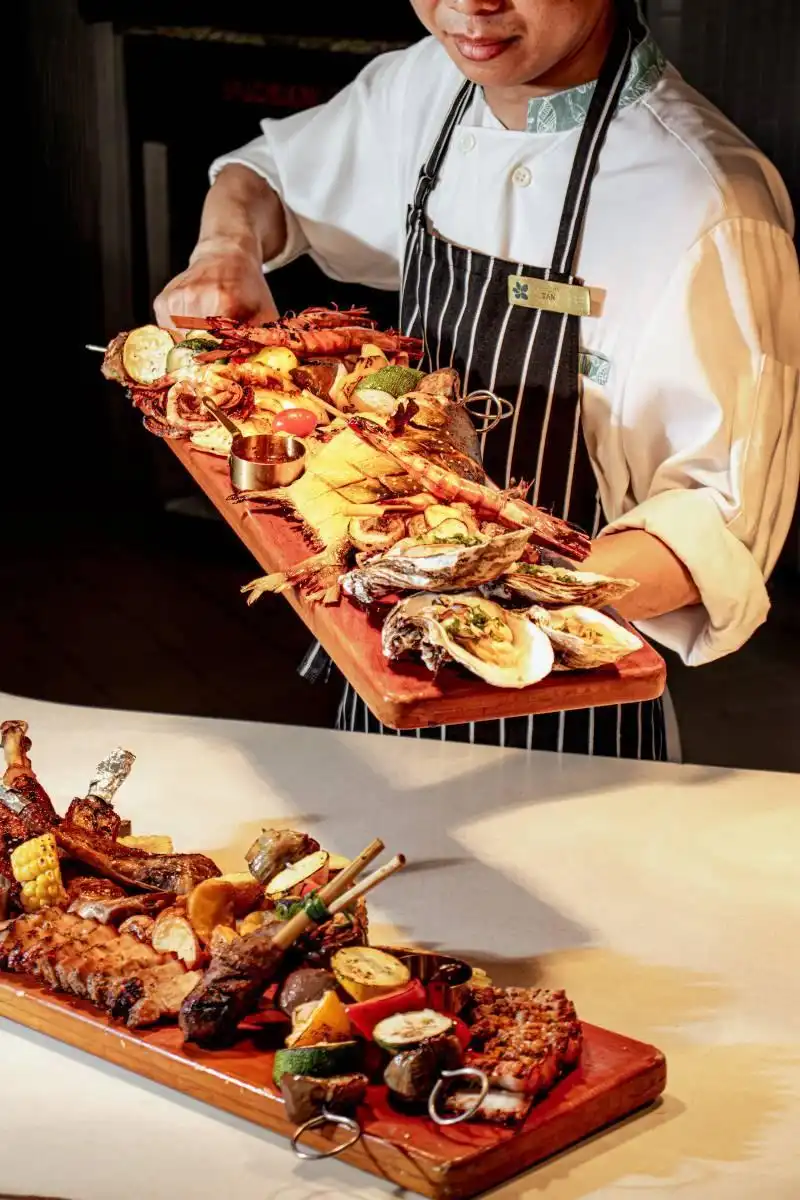
The namesake Herring Salad pairs fresh fish with herbs and peanut sauce, the Oyster & Crab Sauce Salad brings fresh oysters together with rustic fermented crab sauce, and the Grilled Seafood Platter, tiger prawns, oysters, satay squid, and local fish grilled to order, is built for sharing after a long day rather than a single-plate dinner.
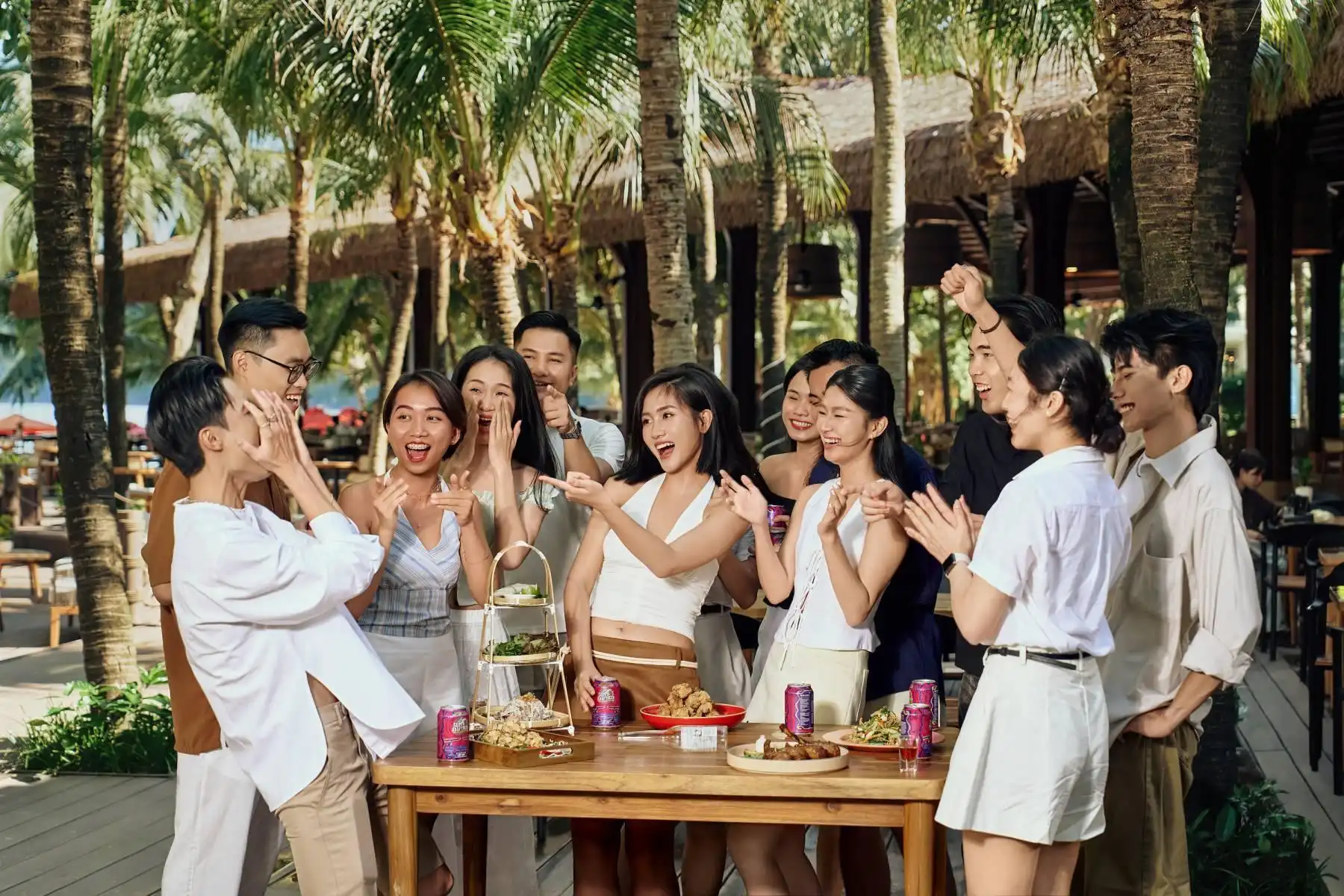
A signature Emerald Splash cocktail closes out a day that started on a hillside temple staircase and ends barefoot in the sand, the panoramic, uninterrupted view of Khem Beach from the bar’s open seating making it worth lingering past the last bite.
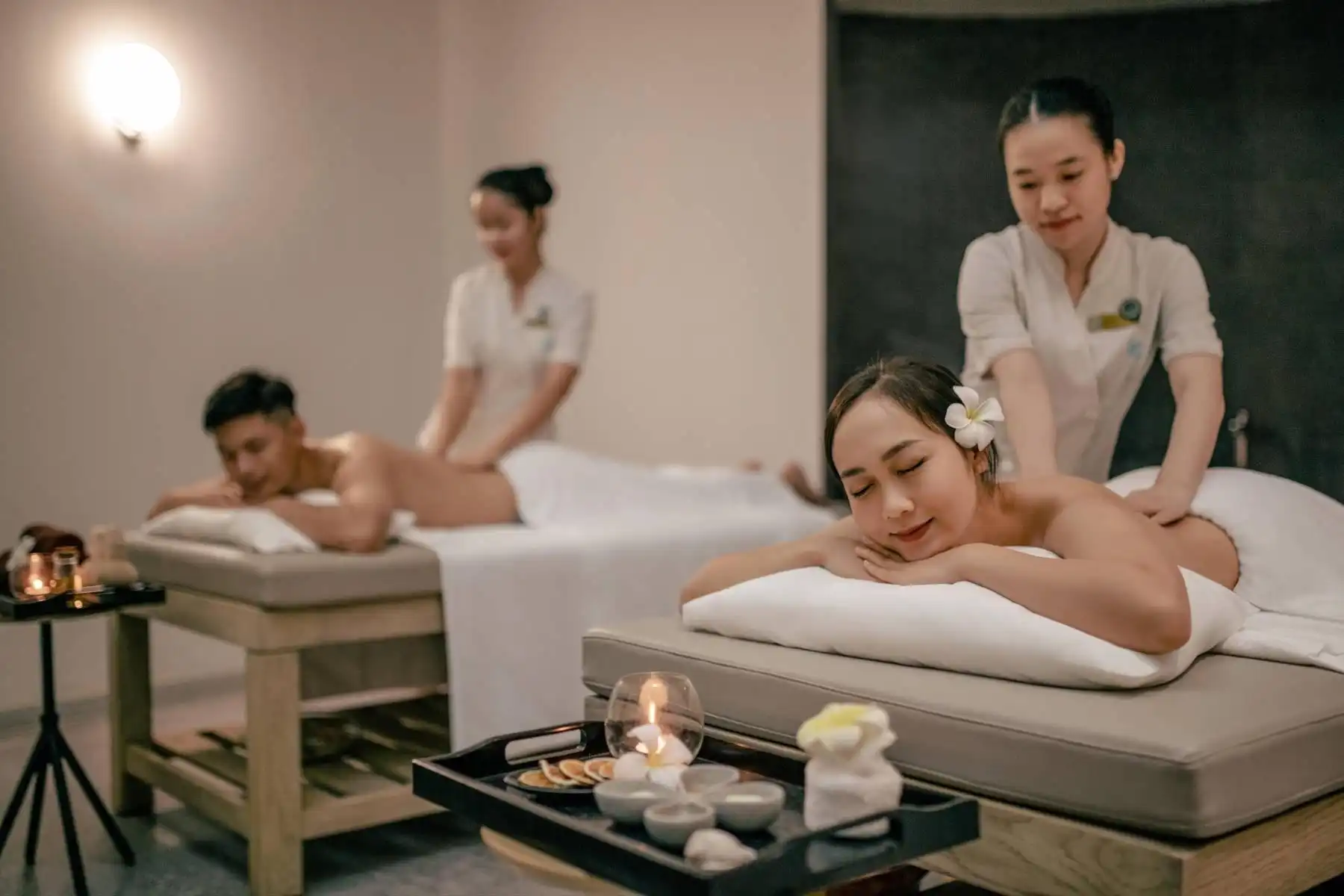
Emerald Spa is worth booking for the late afternoon on the same day, once the temple loop wraps up. The spa’s Afternoon Recharge package pairs a 50-minute body treatment with a Sips & Tastes afternoon tea, using Vietnamese technique alongside natural Italian ingredients, a genuinely restorative reset after a morning spent climbing stone staircases and walking temple grounds in Phu Quoc’s midday heat.
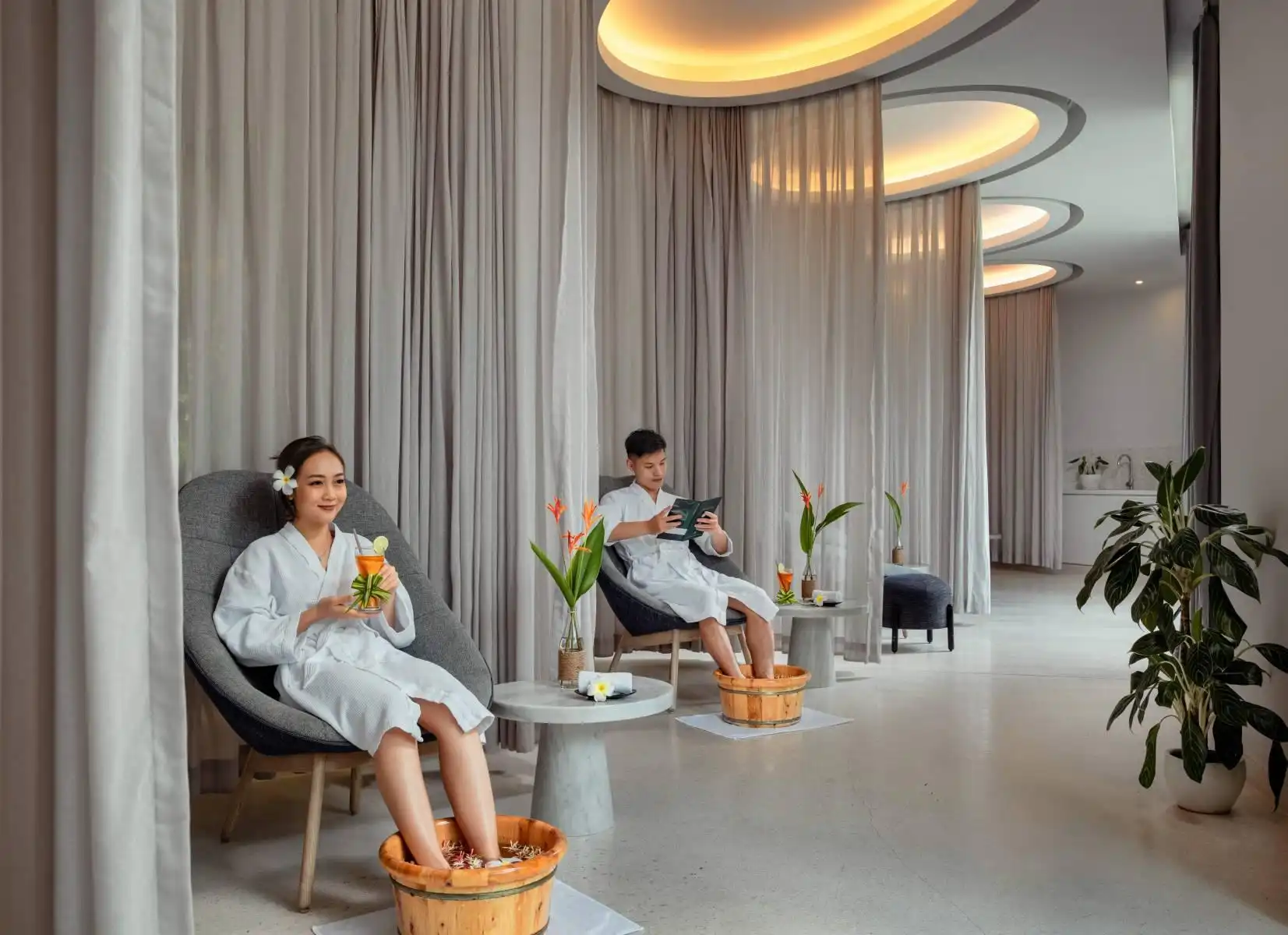
For anyone arriving on the same day as a temple visit, the spa’s Arrival Retreat offers a 30-minute body treatment before check-in, priced at 350,000 VND (about $13 USD) per guest and valid from 15 July through 30 September 2026, a useful way to shake off travel fatigue before setting out for Ho Quoc the same day rather than waiting until the temple loop is done.
Detailed Information:
- Address: Khem Beach, Phu Quoc Special Zone, An Giang Province, Vietnam.
- Phone Number: +84 297 3927 777.
- Reference Price: From approximately $110 USD per night, depending on room type and season.
- Google Review: 4.7 out of 5 (based on over 2,000 reviews).
Conclusion
Ho Quoc Pagoda earns its reputation as Phu Quoc’s defining temple, and Dinh Cau, Sung Hung, and Nguyen Trung Truc round out a fuller picture for anyone who wants more than a single stop.
Reach out to Premier Residences Phu Quoc Emerald Bay directly to arrange transport and book a room for your Phu Quoc pagoda day trip,